+86-158-9507-5134
info@shenchong.com
 EN
EN
Servo CNC press brake bending machines are among the most important core equipment in the modern sheet metal manufacturing industry, and a crucial component of intelligent manufacturing, digital factories, and automated production lines. As the manufacturing industries of new energy vehicles, rail transportation, elevators, chassis and cabinets, construction machinery, aerospace, and home appliances continue to develop towards higher precision, higher efficiency, and higher flexibility, traditional mechanical and ordinary hydraulic press brakes are gradually being replaced by servo CNC press brakes.
Currently, servo CNC press brakes on the market mainly include:
- Single-servo electro-hydraulic press brakes
- Hybrid servo press brakes
- All-electric servo press brakes
Among these, electro-hydraulic servo and hybrid servo press brakes have become the most widely used technologies in industrial applications, while all-electric servo press brakes are more commonly used in ultra-high precision, small-tonnage, and clean manufacturing fields. In recent years, the continuous development of technologies such as servo control, closed-loop feedback, intelligent compensation, graphical programming, and MES interconnection has enabled modern servo CNC bending machines to be significantly superior to traditional hydraulic equipment in terms of precision, energy saving, and automation.
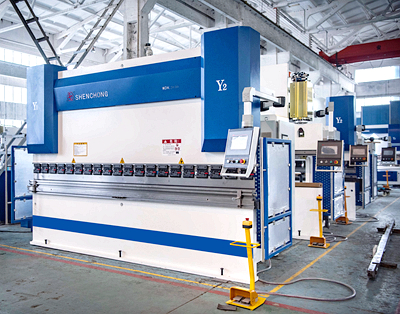
Servo CNC press brake bending machines are a device that utilizes a servo drive system, a CNC system, and closed-loop feedback control to perform high-precision bending of metal sheets.
Compared to traditional bending machines, it employs:
- CNC control system
- High-precision servo drive
- Linear ruler closed-loop feedback
- Multi-axis linkage control
- Automatic compensation system
- Intelligent process database
Achieving:
- Automatic positioning
- Automatic bending
- Automatic compensation
- Automatic angle calculation
- Automatic pressure control
Truly achieving: One-time programming, batch processing, and consistent production.
Servo CNC press brake machine typically refers to bending equipment driven by a servo motor and precisely controlled by a CNC system. It can be a electric servo bending machine, a hybrid servo bending machine, or, in the industry, a "servo-driven CNC bending machine." Regardless of the form, its core objectives are clear: higher precision, faster speed, more stable repeatability, lower energy consumption, and a more intelligent processing experience.
In the sheet metal processing industry, bending machines are not simply machines that "can bend," but must simultaneously meet requirements for dimensional accuracy, angle consistency, production efficiency, energy consumption control, adaptability to complex workpieces, and long-term stability. Servo CNC bending machines excel in these aspects, and are therefore increasingly being used in mid-to-high-end sheet metal processing, precision manufacturing, smart factories, and automated production lines.
The core challenge in bending processes has always been balancing precision, speed, energy consumption, stability, and manual labor. Traditional hydraulic bending machines can handle large tonnage and specifications, but are affected by oil temperature, valve response, leakage risks, and maintenance workload. The core value of the servo hybrid approach lies in finer motion control, reduced idle stroke energy consumption, and stable repeatability.
A complete bending process typically includes:
CAD drawing import
↓ Automatic system unfolding
↓ Calculation of bending sequence
↓ Program generation
↓ Start processing
X-axis
R-axis
Z1
Z2 Automatic positioning.
Positioning accuracy is typically ±0.01~0.02mm (depending on machine configuration).
Servo drive control:
Y1
Y2
Synchronous operation.
Real-time detection by grating ruler:
Position
Speed
Synchronization error
System automatic correction.
The system automatically calculates:
Sheet thickness, springback, die angle, V-groove width
Proceed to the next process.
The entire process requires no manual adjustment.
A high-end servo CNC press brake bending machines typically includes:
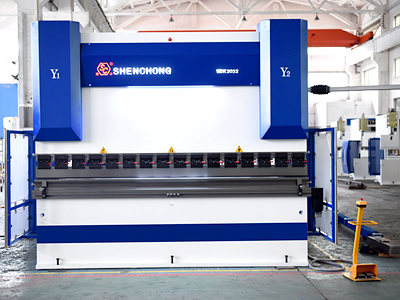
- Integral welding
- Tempering for stress relief
- Large-scale machining center for single-pass processing
Guarantees:
- Rigidity
- Precision
- Long-term stability
Responsible for vertical movement.
Utilizes:
- Electro-hydraulic synchronization
- Dual servo control
- High-rigidity guide rails
Includes:
- Oil tank
- Oil pump
- Proportional valve
- Servo pump
- Hydraulic cylinder
Hybrid models typically use a servo motor to drive the oil pump on demand, supplying oil only during operation, thus being more energy-efficient than traditional hydraulic systems.
Common Brands:
- SC EL Series
- Delem DA Series
- ESA Series
- Cybelec Series
Functions include:
- Graphical programming
- Automatic unfolding
- Interference detection
- Network communication
- Database management
- Automatic compensation
Control:
- Y-axis
- X-axis
- R-axis
- Z-axis
- Compensation axis
Features:
- Fast response
- High precision
- Stable repeatability
Mounted on both sides of the machine body.
Real-time detection:
- Slider position
- Forming closed-loop control
Includes:
- Mechanical compensation
- Hydraulic compensation
- Intelligent compensation
Functions:
- Eliminating deflection.
- Improving angular consistency.
The control precision of servo systems is significantly higher than that of traditional mechanical methods, especially for products with small angles, thin plates, batch production, and high consistency requirements.
It can better control:
- Slider positioning accuracy
- Back gauge position accuracy
- Bending angle consistency
- Stability in repeated processing
Servo motors start and stop quickly, with sensitive action response. The equipment can achieve a better speed curve during rapid approach, feed, and return phases, thereby improving cycle time.
A key advantage of servo systems is "on-demand output."
Compared to traditional hydraulic systems that operate for extended periods and continuously consume energy, servo equipment only outputs energy when action is needed, thus generally being more energy-efficient, especially suitable for frequent start-stop operations or small-batch, multi-variety processing scenarios.
Servo-driven equipment is often quieter than traditional hydraulic presses, especially during standby, idle stroke, and low load phases, resulting in a more environmentally friendly operating environment.
Supports multi-axis control, graphical programming, automatic bending sequence planning, angle compensation, mold database, and other functions, making it suitable for integration with robots, loading/unloading systems, and warehousing systems.
High-end servo CNC press brake bending machines can reduce errors caused by hydraulic fluctuations or mechanical backlash through electronic control, making them particularly suitable for highly repetitive orders.
For workpieces with multiple bends, multiple angles, multiple stations, and high batch consistency requirements, servo CNC systems can significantly reduce setup time and human error.
Compared to traditional hydraulic bending machines, servo CNC bending machines have the following advantages.
Comparison Items | Traditional hydraulic bending machine | Servo CNC press brake bending machine |
Accuracy | Generally | High |
Repeatability | Generally | Excellent |
Energy Consumption | Higher | Low |
Noise | Relatively high | Low |
Machine Setup | Slower | Fast |
Automation | Generally | High |
Maintenance | Requires more hydraulic maintenance | Depending on model, leaning more towards preventative maintenance |
Information Technology | Weaker | Strong |
Purchasing isn't just about tonnage and price, it's about comprehensively assessing whether the equipment truly suits your business. Here are some crucial selection points:
First, confirm the following information:
- Material type: carbon steel, stainless steel, aluminum, galvanized sheet, etc.
- Maximum sheet thickness
- Maximum sheet length
- Common bending angles
- Workpiece dimensional accuracy requirements
- Is it single-piece or batch production?
- Does it need to be integrated with robots or automatic loading/unloading?
Only by clearly defining your requirements can you determine the appropriate tonnage, length, number of axes, and control system.
Higher tonnage isn't always better. Excessive tonnage increases initial investment, energy consumption, and mold costs; insufficient tonnage will affect bending capacity and equipment lifespan.
When selecting a machine, consider the following:
- Sheet material strength
- Sheet thickness
- Bending length
- Lower die opening size
- Bending method (air bending, bottom pressing, stamping)
The CNC system determines the quality of the machine's "brain."
Focus on:
- Whether it supports graphical programming
- Whether it supports automatic angle compensation
- Whether it supports die library management
- Whether it supports multi-step processes
- Whether it supports remote diagnostics or networking
- Whether it is easy to learn and use
Common configurations include:
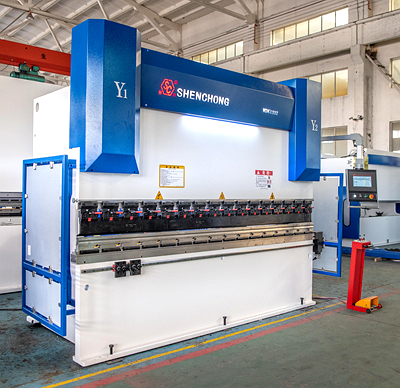
- Y1/Y2: Synchronous control of left and right sliders
- X: Back gauge forward and backward positioning
- R: Back gauge up and down adjustment
- Z1/Z2: Back gauge left and right movement
- V-axis: Deflection compensation
More axes mean greater adaptability to complex workpieces, but also higher costs. Avoid "blindly pursuing more axes" when purchasing; instead, determine the number based on the process requirements.
Frame rigidity directly determines long-term accuracy.
High-quality bending machines typically excel in the following areas:
- High-strength welded frame
- Overall annealing or vibration aging treatment
- Thickened design for key stress-bearing areas
- Resistant to deformation after prolonged use
The accuracy of the back gauge determines the stability of the bending dimensions.
If the back gauge positioning is inaccurate, even with high slider accuracy, the finished product dimensions will deviate.
When bending long workpieces, problems such as "larger in the middle and smaller at both ends" or "inconsistent angles" are prone to occur.
Equipment with a compensation system is more suitable for long plates and high-precision requirements.
The die material, precision, quick-change structure, and wear resistance all affect the processing quality.
Pay special attention to:
- Upper die radius (R-angle)
- Lower die opening
- Die hardness
- Die standardization
- Ease of quick replacement
Bending machines are long-term production equipment, so after-sales service is crucial:
- Is the system easy to maintain?
- Are drives, encoders, and sensors readily available?
- Is technical support available?
- Is local service available?
- Is operation training and process guidance provided?
If you plan to add robots, gantry cranes, smart warehousing, or automated loading/unloading in the future, you should consider interfaces and expansion capabilities in advance during procurement; otherwise, later upgrade costs will be very high.
Maintenance is crucial for the long-term stable operation of bending machines. While servo CNC equipment is more intelligent than traditional equipment, it also relies more heavily on systematic maintenance.
Before starting the machine each day, it is recommended to check:
- power supply stability
- Emergency stop functionality
- Die installation secure
- Back gauge zeroing
- Guide rails and sliders free of foreign objects
- Lubrication adequacy
- Sensor cleanliness
- Air or hydraulic power supply functionality
Sheet metal workshops often have a lot of metal dust, oil, and iron filings, which can easily affect:
- Guide rail accuracy
- Back gauge movement
- Sensor detection
- Electrical control cabinet heat dissipation
- Die mold surface quality
Therefore, the area around the equipment and the machine's guide parts should be cleaned regularly.
Guide rails, lead screws, sliders, and back gauge transmission mechanisms all require lubrication as required.
Insufficient lubrication will lead to:
- Increased resistance
- Slower response
- Decreased accuracy
- Increased mechanical wear
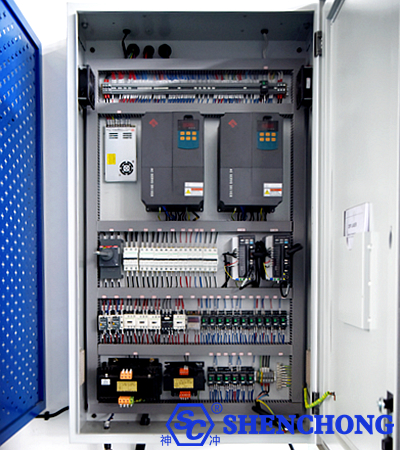
Servo equipment is very sensitive to electrical control.
Pay special attention to checking:
- Loose wiring terminals
- Wearing cables
- Is the driver's heat dissipation adequate?
- Is the electrical cabinet filter clogged?
Voltage fluctuations are excessive.
Incorrect parameter modification will lead to:
- Slider asynchrony
- Back gauge size deviation
- Abnormal return stroke
- Bending angle deviation
Therefore, a parameter management mechanism should be established to avoid arbitrary modifications.
Wearing molds will deteriorate the bending angle and surface quality.
Common symptoms include:
- Obvious bending line indentations
- Unstable angles
- Surface scratches on materials
- Decreased dimensional repeatability
Recommended regular checks:
- Left and right synchronization accuracy
- Back gauge repeatability
- Slider parallelism
- Bending angle consistency
- Consistency between ends and middle of long workpieces
Maintenance records should include:
- Repair time
- Repair content
- Replaced parts
- Abnormal phenomena
- Handling results
- Operator
This helps in tracing problems later and can also detect equipment aging trends in advance.
- Die wear
- Material thickness fluctuation
- Sheet material material change
- Inappropriate parameter settings
- Inaccurate compensation
- Servo control error
- Recalibrate parameters
- Check die
- Confirm material batch
- Re-compare angle compensation
- Inaccurate back gauge positioning
- Incorrect programming parameters
- Inconsistent feeding positioning
- Guide rail wear
- Roughness of machinery
- Check back gauge accuracy
- Reconfirm program
- Check mechanical clearance
- Perform equipment calibration
- Servo driver Abnormal dynamic parameters
- Excessive motor load
- Insufficient lubrication
- Unstable voltage
- Mechanical jamming
- Check the electrical system
- Clean the guide structure
- Replenish lubrication
- Check alarm codes
- Rough die surface
- Improper gap between upper and lower dies
- Insufficient material protection
- Inappropriate bending method
- Replace or repair the die
- Optimize the die opening
- Adjust the process
- Synchronization error
- Frame deformation
- Wear of guide rails or lead screws
- Uneven load on the left and right sides
- Check the synchronization system
- Perform mechanical calibration
- Check compensation parameters
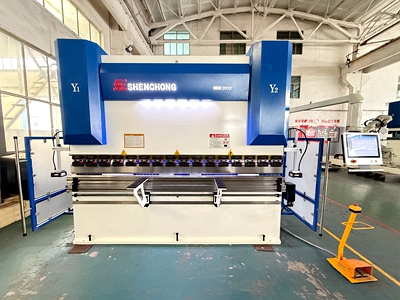
Servo CNC press brake bending machines represent the development direction of sheet metal bending equipment towards high precision, high efficiency, low energy consumption, and intelligence.
Its core value lies not only in its ability to "bend," but also in its ability to stably, quickly, cost-effectively, and consistently complete high-quality bends.
For modern sheet metal companies, servo CNC plate bending machines are no longer just production tools, but also crucial equipment for enhancing competitiveness. They are suitable for both high-precision single-piece production and batch production of standard parts. They can meet current production needs while also allowing for future automation upgrades. With proper selection and maintenance, they can provide long-term, stable returns for businesses.