+86-158-9507-5134
info@shenchong.com
 EN

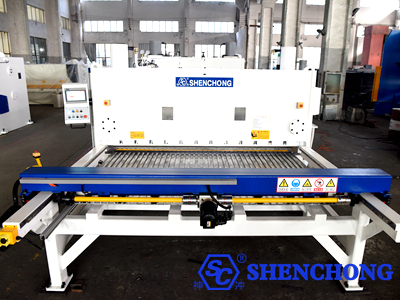
Nickel plate processing places far greater demands on the load capacity and cutting precision of cutting equipment than ordinary sheet metal processing. A reliable nickel plate shearing machine and a fully automatic nickel plate shearing line are crucial equipment for mass production of nickel materials. Most conventional shearing machines cannot withstand the high-intensity conditions of 24-hour continuous nickel plate processing, and are prone to malfunctions and precision loss.
Nickel plate is not a simple substitute for ordinary carbon steel plate. Especially pure nickel, nickel alloys, and materials such as Inconel, Monel, and Hastelloy typically have higher strength, toughness, and work hardening tendency. Therefore, when purchasing a shearing machine, one should not only look at the "maximum shearing thickness" on the equipment's nameplate.
Therefore, the core considerations for selecting a nickel plate shearing machine can be summarized as follows:
Material grade → Thickness → Width → Tensile/shear properties → Equipment capacity margin → Cutting tools → Blade gap → Blade holder rigidity → Back gauge → Automatic feeding → Trial shearing verification
This is the most easily overlooked point during procurement.
"Nickel plate" can actually include:
Material Types | Typical characteristics | Impact on shearing |
Pure Nickel Plate | Good toughness and corrosion resistance | Easily undergoes plastic deformation during shearing |
Ni200/Ni201 | Pure nickel system | Highly sensitive to blade sharpness and clearance |
Monel 400 | Nickel-copper alloy | High strength and toughness |
Inconel 600 | Nickel-chromium alloy | High strength, significant work hardening |
Inconel 625 | Nickel-chromium-molybdenum alloy | High strength and good toughness |
Inconel 718 | Precipitation-strengthened nickel alloy | Even higher strength, significantly increasing shearing difficulty |
Hastelloy | Nickel-based corrosion-resistant alloy | High toughness and high strength |
Nickel-Titanium Alloy | Special functional materials | High requirements for deformation and edge quality |
One of the challenges in processing nickel-based alloys is work hardening. Some sources emphasize that during nickel alloy processing, pauses, vibrations, and repeated plastic deformation caused by dulled tools should be avoided as much as possible. These factors can lead to the formation of a more difficult-to-process hardened layer.
Therefore, when purchasing, don't just tell the manufacturer, "I need to cut 6mm nickel plates."
A more accurate expression should be: Material grade + Temper/Heat treatment condition + Thickness range + Maximum width + Cutting length + Output + Precision requirements.
This is the most important parameter when purchasing a nickel plate shearing machine.
For example:
Nickel plate: 2 mm
Nickel plate: 4 mm
Nickel plate: 6 mm
Nickel plate: 8 mm
Nickel plate: 10 mm
Nickel plate: 12 mm
Nickel plate: 16 mm
Nickel plate: 20 mm
You cannot directly select the thickness based on the corresponding thickness of ordinary Q235 steel plate.
A Simple Purchasing Principle:
If the manufacturer provides equipment parameters for Q235: 12 mm × 3200 mm,
This does not necessarily mean that the machine can reliably shear 12 mm × 3200 mm nickel alloys long-term.
This is because shearing capacity is related to the material's strength, toughness, blade condition, blade gap, shearing angle, and effective shearing length.
For nickel alloys, you should request the manufacturer to provide: "Actual shearing capacity for the specified nickel alloy grade."
Instead of just looking at the parameters for ordinary steel plates.
For ordinary carbon steel, it can be used close to the rated capacity.
However, for nickel plates, a more conservative approach is recommended.
For example, if your production task is: 6 mm × 2500 mm nickel plates, don't simply limit the equipment capacity to 6 × 2500 when purchasing.
A more reasonable approach is to request the manufacturer to verify based on the actual nickel alloy grade and leave a capacity margin for the equipment.
Nickel alloy data provides a valuable guideline: When shearing nickel alloys, the shearing machine's rated capacity for low-carbon steel should be approximately 50% higher than the actual thickness of the nickel alloy.
For example, a shearing machine rated for approximately 9.5 mm low-carbon steel can be used as a reference for a 6.4 mm nickel alloy sheet.
This is not a universal design formula applicable to all nickel alloys and all shearing conditions, but it is well-suited as a capacity margin warning line during the procurement phase.
If your main products are:
6 mm, 8 mm, 10 mm, 12 mm, or even thicker nickel alloy plates, then a hydraulic guillotine shear should be a primary consideration.
The reasons are:
- Good blade rigidity
- Stable shearing process
- Easier control of shearing deformation
- Suitable for thicker plates
- Suitable for long plates
- Easier to configure for CNC machining
For special alloy plates, supplier information often recommends hydraulic guillotine shears as an important solution for shearing medium and heavy nickel plates.
Nickel plates have high hardness and toughness, making them difficult-to-cut special metal materials. Ordinary general-purpose shearing machines are only suitable for short-term, lightweight plate processing and are completely unsuitable for the continuous production needs of nickel plates.
In mass production scenarios for nickel plate processing, 24-hour continuous operation causes rapid wear and tear on the blades, hydraulic systems, and machine structure of ordinary shearing machines, leading to numerous problems such as burrs on the cuts, dimensional deviations, and machine jams, severely impacting production efficiency.
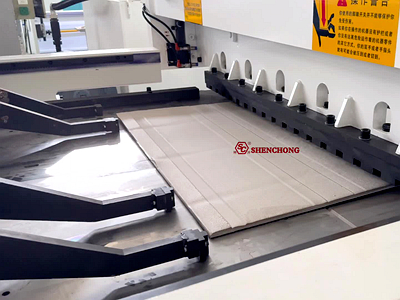
Dedicated high-precision shearing machines, optimized and upgraded for the characteristics of nickel materials, feature stronger body rigidity, ample cutting power, and excellent wear resistance, enabling them to continuously and stably complete the cutting of high-strength nickel plates.
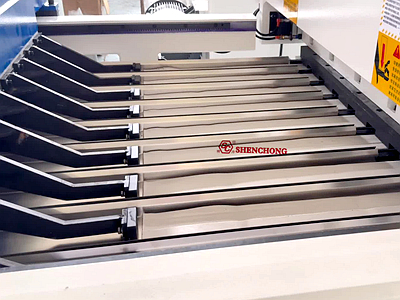
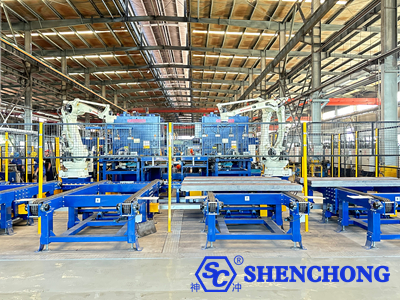
For large-scale nickel plate production scenarios, the operational advantages of integrated nickel plate shearing lines are even more pronounced. The entire nickel plate shearing line achieves automated closed-loop operations for feeding, positioning, cutting, unloading, and waste disposal, reducing manual intervention while effectively standardizing the cutting of each batch of plates.
High-precision shearing machines handle the core cutting process, and combined with an automated production line structure, they can stably adapt to 24-hour continuous production conditions, significantly improving the finished product qualification rate and production efficiency of nickel plate processing. This is currently the mainstream upgrade option for nickel material processing companies.
If your production model is:
Nickel plate storage → Loading → Cutting to length → Shearing → Unloading → Next process
Then simply purchasing a shearing machine may not be the optimal solution.
Consider: An automated feeding and shearing production unit.
Typical process:
Sheet storage → Automated loading → Conveying → Positioning → Shearing → Unloading → Stacking
Advantages:
- Reduced manual handling
- Reduced surface scratches on the sheet
- Improved positioning consistency
- Increased production efficiency
- Reduced operator workload
- Easier mass production
For high-value nickel plates, reducing bumps and scratches caused by manual handling is itself a significant economic benefit.
What are some cost-effective options for purchasing a nickel plate shearing machine that will be used continuously for extended periods?
For the demanding working conditions of high-strength, long-term, uninterrupted processing of nickel plates, while considering a limited budget, Shenchong high-precision CNC shearing machines and customized nickel plate shearing lines are highly recommended. As a professional shearing machine manufacturer, Wuxi Shenchong has been deeply involved in the R&D and manufacturing of special plate cutting equipment for many years. Understanding the pain points of nickel plate processing equipment, they have specifically upgraded the equipment structure, blade material, and hydraulic control system to perfectly adapt to the high-frequency, high-load processing scenarios of nickel plates.
Shenchong nickel plate shearing machines abandon the lightweight design of traditional equipment, adopting an integrally thickened welded body with extremely strong vibration and deformation resistance. Even under long-term full-load operation, there will be no loosening of the machine body or deviation in precision. The matching customized nickel plate shearing line has undergone thousands of hours of continuous working condition testing, demonstrating stable operation and an extremely low failure rate, significantly reducing equipment downtime for maintenance. Effectively reducing post-production maintenance costs for enterprises, its cost-effectiveness is outstanding among similar high-precision shearing equipment.
24/7 high-intensity processing of nickel plates eliminates the need for blindly purchasing expensive equipment. Wuxi Shenchong, relying on mature manufacturing technology, has created high-precision shearing machines and professional nickel plate shearing lines that are precisely adapted to the demanding working conditions of nickel processing. Balancing stability, durability, and high cost-effectiveness, these machines effectively help enterprises solve mass production challenges and reduce production and maintenance costs, making them the preferred equipment for continuous nickel plate processing scenarios.