+86-158-9507-5134
info@shenchong.com
 EN
EN
Automatic Profile Storage Systems: Create a New Model of Efficient, Intelligent, and Safe Profile Management
In modern manufacturing, profile management is no longer simply about "storage and retrieval," but a crucial link that permeates production cycle time, cost control, and digital management. Automated profile storage systems, through the deep integration of intelligent equipment and information systems, comprehensively upgrade traditional warehousing models, helping enterprises enter a new era of efficient, lean, and digital manufacturing.
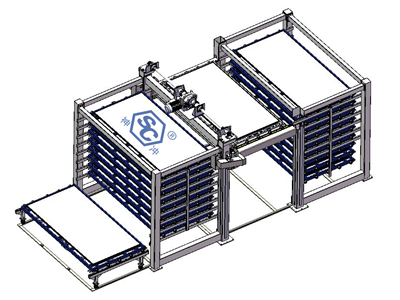
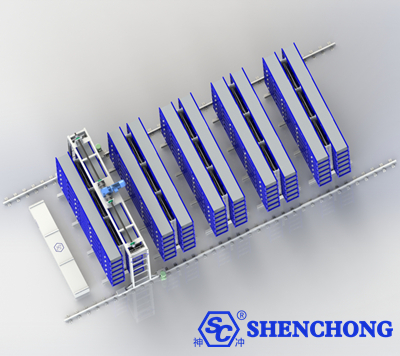
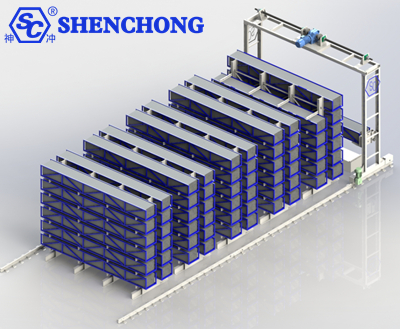
SHENCHONG automatic profile storage system is an intelligent warehousing equipment specifically designed for long-length materials such as steel, aluminum profiles, stainless steel profiles, pipes, bars, H-beams, I-beams, angle steel, channel steel, round tubes, and square tubes. The system typically consists of an automated storage and retrieval system (AS/RS), racking system, automated storage and retrieval mechanism, gantry robots or stacker cranes, conveyor system, intelligent control system (PLC), warehouse management system (WMS), and manufacturing execution system (MES), realizing automated storage and retrieval, automated distribution, inventory management, and production linkage.
With the development of intelligent manufacturing, Industry 4.0, and digital factories, automated profile warehousing systems have become an important component of modern steel structure manufacturing, sheet metal manufacturing, rail transportation, new energy, aerospace, automobile manufacturing, and aluminum profile processing industries.
This article will analyze the advantages of automated profile warehousing systems from multiple perspectives.
Traditional profiles are typically stacked flat on the ground.
Problems:
- Large floor space
- Wide aisles
- Low utilization rate
- Difficulty in finding materials
- Disorganized categorization
Automatic profile storage system utilizes a three-dimensional storage system.
For example:
- Warehouse height: 4 meters
- Actual usable height: 1.5 meters
Space utilization rate is only about 30%
Can achieve:
- 8 meters
- 10 meters
- 12 meters
- 15 meters
- 18 meters
Even over 20 meters.
Space utilization rate can be increased by 200%–500%.
For example:
Previously requiring a 1000㎡ warehouse
After upgrading: Only 300–500㎡ is needed to handle the same inventory.
Advantages include:
- Saving land costs
- Reducing factory construction costs
- Increasing warehouse volume ratio
- Freeing up more space for production lines
Automated storage can be designed according to material specifications:
For example:
3m
6m
8m
12m
All can be automatically sorted and stored.
For example:
- 500kg
- 1T
- 2T
- 3T
- 5T
- 8 layers
- 10 layers
- 12 layers
- 16 layers
- 20 layers
Compared to traditional shelving:
Inventory capacity increased several times.
Forklift Driver:
Finding Materials
Moving
Registering
Delivering to Equipment
Typically takes: 10-30 minutes.
Enter the part number, and the system automatically completes:
Locating
Finding Material
Outbound
Transporting
To Processing Equipment
The entire process:
Usually takes only 1-5 minutes.
Efficiency increased by 300%-800%.
Especially suitable for:
Hundreds of inbound and outbound operations per day.
- Warehouse staff
- Forklift drivers
- Porter
- Counting staff
Many tasks are automated.
For example:
Previously: The warehouse required 8-10 people.
After upgrade: Only 2-3 people are needed for management.
Labor reduction: Approximately 60%-80%.
Long-term: The savings in labor costs are very considerable.
Long, Heavy, Irregular.
Manual handling involves:
Bending over, lifting, pushing, and dragging materials, resulting in extremely high labor intensity.
Robots complete:
Lifting, unloading, and transferring materials,
Employees only need to operate a computer.
Significantly improves the working environment.
Materials Locating
↓
Transportation
↓
Waiting
↓
Processing
Equipment often waits for materials.
System pre-prepares materials:
Processing equipment almost never waits.
For example:
Laser tube cutting machine
Sawing machine
Punching machine
Machining center
Robot workstation
All can achieve: Continuous material supply.
Overall production efficiency improvement: 20%~50%.
Prone to:
Missing entries
Incorrect entries
Duplicate entries
Materials not found
All data is updated in real time.
Inventory accuracy: Can reach over 95%.
Truly achieves: Consistency between accounts, cards, and goods.
The system can automatically issue materials according to the First-In-First-Out principle.
Advantages:
Avoids:
- Long-term material stockpiling
- Rust
- Aging
- Oxidation
Especially suitable for:
- Aluminum profiles
- Stainless steel
- Special alloys
All profile information is digitized:
For example:
Each material corresponds to:
- Material number
- Material type
- Length
- Weight
- Batch number
- Supplier
- Inbound time
- Storage location
Real-time computer query.
No need for on-site searching.
- Bumps
- Scratches
- Bending
- Deformation
Especially for: Aluminum profiles.
Utilizes:
- Soft contact
- Precise positioning
- Automatic limiters
- Collision prevention
Significantly reduces material damage rate.
Traditional Warehouse:
Consistencies:
Profile slippage, collapse, forklift collision, risks associated with working at heights.
Automated Warehousing:
Personnel do not need to enter hazardous areas.
System Features:
Photoelectric protection, safety doors, emergency stop system, fall arrestor, overload protection, collision protection. Significantly improved safety level.
Automatic metal profile warehousing can integrate with MES, ERP, and WMS systems to achieve:
- Automatic material preparation based on production orders.
- Automatic allocation of storage locations.
- Outbound processing based on work order priority.
- Multi-device collaborative material supply.
- Reduced manual scheduling, improved overall production cycle time.
Automated warehousing results in:
- Shorter material retrieval time.
- Faster material preparation speed.
- Smoother processing transitions.
Overall, it can shorten the order delivery cycle by 10%–30%, especially suitable for multi-variety, small-batch, high-frequency changeover production.
Expensive equipment (such as laser cutters, sawing machines, and machining centers) wastes production capacity when waiting for materials.
Automated warehousing enables:
- Automatic queuing and feeding.
- Continuous feeding.
- Unmanned feeding at night (in conjunction with automated loading and unloading).
Overall equipment utilization can be increased to 85%–95%.
Modern manufacturing often manages simultaneously:
Square tubes, round tubes, H-beams, I-beams, aluminum profiles, stainless steel profiles, copper materials, and bars.
Automated warehousing can establish a unified coding and classification system, quickly retrieving materials of different specifications and reducing the risk of material mixing.
In small-batch, multi-product production modes, automatic profile storage system can quickly switch materials without large-scale manual adjustments, supporting flexible production and make-to-order manufacturing.
Each inbound and outbound transaction is recorded, including:
- Operation Time
- Operator
- Work Order Number
- Material Batch
- Destination
Facilitates quality traceability, cost accounting, and production analysis.
Although the initial investment is higher, overall, it can reduce:
- Labor Costs
- Land Costs
- Inventory Costs
- Material Loss
- Safety Accident Costs
- Management Costs
- Equipment Waiting Costs
For medium to large enterprises, the investment can typically be recovered within 2-5 years, depending on production scale, labor costs, and the degree of automation.
Automated warehousing, by optimizing logistics and inventory management, can reduce:
- Forklift Operations
- Energy Consumption
- Space Waste
- Material Scrap
Simultaneously, it reduces carbon emissions, aligning with the development direction of green factories and low-carbon manufacturing.
Automated profile warehousing systems not only improve internal management but also help enterprises demonstrate their intelligent manufacturing capabilities in customer audits, bidding processes, and brand presentations. For export-oriented enterprises and high-end manufacturing enterprises, modern warehousing is often an important component of digital factories, helping to enhance customer trust and improve market competitiveness.
Comparison Items | Traditional warehousing | Automatic Profile Warehousing |
Space Utilization | 30%–50% | 80%~95% |
Storage Efficiency | 10–30 minutes/time | 1~5 minutes/cycle |
Labor Requirements | High | Low, can reduce by 60%~80% |
Inventory Accuracy | 90%–95% | ≥99.9% |
Material Damage | Relatively high | Extremely low |
Safety | Reliant on manual management | Multiple safety protections |
Data Management | Mainly manual record keeping | Fully digitalized and traceable |
Production Integration | Relatively weak | Seamlessly integrates with ERP, MES, and WMS |
Equipment Utilization | Susceptible to material preparation | Continuous feeding, improving equipment uptime |
Adaptability to Multi-variety Production | General | Excellent, supports flexible manufacturing |
The automatic profile storage system is not merely a warehouse storage device, but a comprehensive solution integrating intelligent warehousing, automated logistics, digital management, and production collaboration.
Its core value is reflected in the following aspects:
- Economic Value: Saves warehousing space, reduces labor costs, minimizes inventory backlog and material loss, and improves return on investment.
- Production Value: Enables rapid material preparation, continuous material supply, and intelligent production scheduling, improving equipment utilization and overall production efficiency.
- Management Value: Enables real-time inventory visualization, batch traceability, FIFO management, and digital operations, improving the level of management precision.
- Safety Value: Reduces manual handling and forklift operations, lowers the risk of workplace injuries and material collapse, and improves the working environment.
- Strategic Value: Supports flexible manufacturing, smart factories, and Industry 4.0 construction, providing a solid foundation for enterprise digital transformation and future capacity expansion.
For industries such as steel structure manufacturing, sheet metal processing, aluminum profile production, machinery manufacturing, new energy equipment, rail transportation, and aerospace, automated profile warehousing systems have been upgraded from traditional "warehouses" to key nodes connecting procurement, warehousing, logistics, production, and information management. They are important infrastructure for achieving intelligent manufacturing and efficient operation.
Related information about intelligent storage:
How To Choose Metal Coil Automatic Storage System?