+86-158-9507-5134
[email protected]
 EN
EN

Four-roll Plate Bending Machine production efficiency and rolling accuracy depend not only on the equipment itself, but also on many other aspects such as equipment structure, hydraulic system, CNC system, process parameters, operating methods, tooling and molds, material properties, maintenance, automation level, personnel training, and digital management.
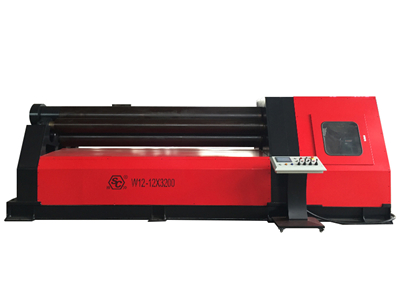
Four-roll plate rolling machines are crucial forming equipment in modern sheet metal manufacturing, pressure vessels, wind turbine towers, petrochemicals, shipbuilding, construction machinery, bridge steel structures, and storage tank manufacturing industries. With advantages such as single-pass centering, continuous rolling, strong pre-bending capacity, and high automation, four-roll plate bending machines have gradually replaced traditional three-roll plate rolling machines, becoming the mainstream equipment for rolling mid-to-high-end sheet metal.
However, in actual production, many companies still face the following problems:
- Low production efficiency and long changeover times.
- Large roundness errors.
- Excessively long straight edges requiring secondary trimming.
- Poor consistency within the same batch of products.
- High dependence on operator skills.
- Severe sheet metal slippage.
- Thick plates are prone to elliptical formation.
- Difficulty in rolling high-strength steel and stainless steel.
- Insufficient automation and excessive manual intervention.
Therefore, how to comprehensively improve the production efficiency and rolling accuracy of four-roll plate rolling machines has become a crucial issue for sheet metal manufacturing companies to enhance their competitiveness.
This article will conduct a systematic analysis from multiple aspects, including equipment structure, hydraulic system, control system, mechanical precision, process optimization, operation method, automation configuration, material management, maintenance, and intelligent manufacturing.
Before improving efficiency, it's essential to identify the influencing factors.
These can generally be summarized into ten aspects:
- Whether it is prone to deformation
- Whether it is prone to running out of round
- Whether it can maintain precision over a long period
Including:
- Frame rigidity
- Base rigidity
- Welding quality
- Stress relief process
A high-rigidity frame ensures:
- Smaller asynchrony on both sides
- More uniform rolling pressure
- No taper in thick plates
Therefore:
Equipment rigidity determines basic precision.
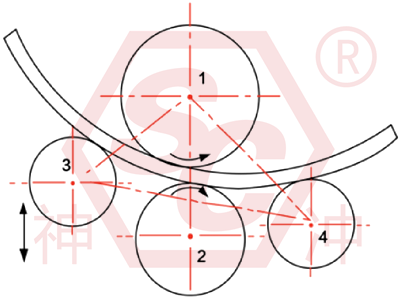
The core of a four-roll plate rolling machine is its four work rolls.
- Upper roller
- Lower roller
- Left roller
- Right roller
- Cylindricity
- Coaxiality
- Runout
- Surface roughness
- Radial runout: ≤0.03mm
- Large equipment: ≤0.05mm
- Increased roundness error
- Wavy edges
- Surface indentations
The hydraulic cylinders on both sides of the four-roll plate bending machine must be synchronized.
If:
- Left side is faster
- Right side is slower
It is easy to:
- Convex
- Off-center rounding
- Different dimensions at both ends
Modern equipment usually uses:
Proportional valve synchronization or servo hydraulic synchronization.
Synchronization error is generally controlled: ≤0.10mm
Higher-end equipment: ≤0.05mm
Automatic:
- Pressing down
- Pre-bending
- Rolling
- Rounding
- Correcting
Also can:
- Automatically save parameters
For example:
Machining: φ800×8mm Q235 Directly recall next time.
No need to re-roll.
Even with excellent equipment, incorrect operation methods can still reduce efficiency by more than 30%.
For example:
Incorrect pressure application, insufficient pre-bending, inconsistent adjustments on both sides, and repeated rounding adjustments
All of these will increase operating time.
Improving efficiency should start with optimizing the entire processing flow.
This is the biggest advantage of four-roller machining.
Positioning
↓
Clamping
↓
Pre-bending
↓
Rolling
↓ R
ounding
↓
Unloading No flipping is required throughout the entire process.
Compared to three-roller machining:
Efficiency increased by 20%–50%.
Different materials:
For example:
- Q235
- 304
- 316L
- NM400
- Q690
Including:
- Thickness
- Width
- Roll diameter
- Pressure amount
- Compensation amount
- Rounding times
Form a parameter database.
Subsequently: One-click recall.
Reduce the number of test rolls.
Modern CNC systems support programmed machining.
For example:
Batch: 100 pieces
Same specifications: Directly and automatically completed.
Reduce: Manual intervention.
Significantly improve consistency.
Many companies:
The actual rolling process takes only 3 minutes.
However, loading and unloading takes 8 minutes.
Therefore:
Recommended configurations:
- Vacuum suction cups
- Crane linkage
- Automatic loading
- Automatic unloading
- Tilting mechanism
Large enterprises can adopt:
Robot loading and unloading.
Overall efficiency:
Can be improved by more than 30%.
For example:
Don't finish rolling and then round it.
Instead:
Pre-bending
↓
Rolling
↓
Online rounding
↓
Completed in one go
Reducing: Rework.
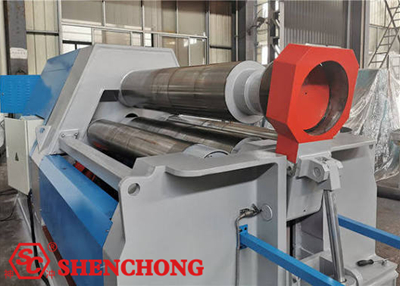
Pre-bending determines: the final straight edge length.
General requirements:
- Straight edge: ≤1.5 times the plate thickness
- Excellent equipment: ≤1 times the plate thickness
The more thorough the pre-bending, the better the subsequent roundness.
Too small a pressing amount easily leads to springback.
Too large a pressing amount easily leads to localized damage. Generally, the pressure is increased gradually, rather than applied all at once.
For example:
- First time: 60%
- Second time: 80%
- Third time: 100%
This results in more uniform material stress.
Add 1-3 rounds of low-pressure rounding at the end.
Improves:
- Elliptical shape
- Local bulging
- Roundness
Many companies:
Add only: 20 seconds
Roundness improvement: Over 40%
Slippage is a significant factor affecting accuracy.
Causes include:
- Insufficient lower roller pressure
- Oil on the sheet
- Wear on the lower roller
- Insufficient friction
Solutions:
Increase:
- Clamping pressure
- Clean the sheet
- Inspect the roller surface
- Increase the coefficient of friction
Characteristics: Good plasticity.
Recommendation:
Speed: Medium to high speed.
Roll in one pass.
Highest efficiency.
Characteristics: High springback.
Recommendation:
Increase: 5%–10% reduction.
Decrease: Rolling speed.
Increase: Rounding.
Examples:
Q690
Q960
Recommendation:
Reduce speed.
Segmented rolling.
Increase:
Intermediate stress release.
Avoid: Cracks.
Characteristics: Easily damaged by pressure.
Recommendations:
Polyurethane protective film, mirror roller, low pressure, slow speed.
Modern four-roll plate bending machines can be configured with:
Real-time detection of diameter.
Automatic correction of reduction amount.
No manual measurement required.
Real-time detection of roundness.
Immediate error compensation.
Improved consistency.
Automatic detection of plate center.
Prevents deviation.
Improves rolling quality.
Suitable for batch processing.
Reduces manual labor.
Efficiency increased by 20%-40%.
Especially for large cylinders.
No manual material handling required.
Enhanced safety.
Many companies only know how to repair, not how to maintain. In fact, the better the maintenance of a four-roll plate bending machine, the higher its work efficiency.
Key points include:
- Lubrication
- Cleaning
- Check oil level
- Check pressure
- Check seals
Check:
- Synchronization accuracy
- Chain
- Bearings
- Fasteners
Inspect:
- Hydraulic oil contamination
- Proportional valve
- Encoder
- PLC alarms
Excellent enterprises not only possess advanced equipment, but also prioritize effective management.
Recommendation:
Establish: Standard process cards.
Fix the following for each product:
- Pressing amount
- Speed
- Number of passes
Operators must strictly adhere to these guidelines.
Reduce human error.
With the development of Industry 4.0, four-roll plate bending machines are gradually upgrading towards digitalization and intelligence. Efficiency and accuracy can be further improved in the following aspects:
Integrating the plate rolling machine into an MES (Manufacturing Execution System) enables:
- Automatic work order issuance
- Automatic processing parameter recall
- Real-time production progress monitoring
- Automatic processing data upload
- Product quality traceability.
This reduces manual data entry time, avoids parameter input errors, and achieves transparent management throughout the entire production process.
Advanced CNC systems can build a database based on historical processing data. By statistically analyzing the optimal pressing amount, rolling speed, and compensation amount for different materials, thicknesses, and diameters, a company's own "expert process library" can be gradually formed.
For repeat orders, mature processes can be directly applied, reducing test paper time and improving the first-piece yield rate.
Real-time data collection using sensors:
- Hydraulic pressure
- Roller load
- Motor current
- Oil temperature
- Vibration
- Bearing temperature
When abnormal trends appear, the system provides early warnings, enabling predictive maintenance and avoiding downtime due to sudden failures.
Statistical analysis of the following key indicators:
- Single-piece processing cycle time
- Overall Equipment Effectiveness (OEE)
- First-piece yield rate
- Rework rate
- Changeover time
- Downtime due to failure
Continuous analysis can identify bottlenecks and develop improvement measures for continuous optimization.
Common problems | Main Causes | Improvement Measures |
Poor roundness | Insufficient roller synchronization and insufficient pressing amount | Correct the synchronization system and optimize the pressing curve |
Excessively long straight edges at both ends | Insufficient pre-bending | Increase pre-bending pressure and raise the side roller position |
Cylinder taper | Inconsistent pressure on both sides | Calibrate the hydraulic synchronization to improve frame accuracy |
Sheet slippage | Insufficient clamping force of the lower roller; Oil contamination on the sheet material | Increase clamping pressure and clean the sheet metal |
Surface indentation | Wear or impurities on the roller surface | Re-grind the roller shafts and keep the roller surface clean |
Severe springback | High material strength | Increase the overwind amount and the number of rounding cycles |
Poor repeatability | Non-standardized process parameters | Establish a process database to achieve programmed processing |
Low processing efficiency | Long loading and unloading time | Configure automatic loading, unloading, and flipping devices |
High equipment failure rate | Inadequate maintenance | Establish a preventative maintenance system |
For enterprises aiming to improve their competitiveness, it is recommended to implement the following phased approach, "from basic to intelligent":
- Correct the overall machine's geometric accuracy
- Detect roller runout and coaxiality
- Calibrate the hydraulic synchronization system
- Replace worn bearings and seals
- Establish a daily inspection system
- Establish a database of rolling process parameters for different materials
- Develop standardized operating procedures (SOPs)
- Provide unified training for operators
- Implement first-piece verification and process inspection systems
- Configure an automatic centering system
- Add automatic loading and unloading mechanisms
- Introduce automatic diameter measurement and laser detection devices
- Achieve programmed batch processing
- Integrate with MES, ERP, and other information systems
- Establish equipment networking and remote monitoring
- Implement predictive maintenance
- Continuously optimize process parameters using production data
If the above measures can be systematically implemented, a four-roll plate bending machine can typically achieve the following improvements (specific values will vary depending on the equipment model, materials, and processes):
Optimization Projects | Improvement Effect (Reference Values) |
Single-piece processing efficiency | Increase by 20%–50% |
Batch production efficiency | Increase by 30%–60% |
First-piece yield rate | Increase to over 95% |
Roundness accuracy | Increase by 20%–40% |
Repeatability accuracy | Increase by approximately 30% |
Rework rate | Decrease by 30%–70% |
Material waste | Decrease by 10%–20% |
Labor intensity | Decrease by over 30% |
Overall equipment efficiency (OEE) | Increase by 15%–30% |
The production efficiency and rolling precision of a four-roll plate bending machine are not determined by a single factor, but rather by the combined effects of equipment performance, mechanical precision, hydraulic synchronization, CNC system, rolling process, material properties, automation configuration, maintenance, and production management.
From industry practice, companies that truly achieve high-efficiency, high-precision processing typically adhere to the following principles:
Based on high-rigidity, high-precision equipment to ensure long-term stable operation.
Using standardized processes and process databases as the core to reduce reliance on individual experience.
Focusing on CNC, automation, and intelligentization to shorten auxiliary time and improve consistency.
Maintaining optimal equipment operating conditions through preventative maintenance and data-driven management.
Continuously improving processing capabilities and product quality through continuous optimization and employee training.
In the future, with the continuous maturation of servo hydraulic control, digital twins, artificial intelligence process optimization, and industrial internet technology, four-roll plate bending machines will further develop towards higher speed, intelligence, higher precision, and flexibility, providing more efficient, stable, and precise plate rolling solutions for industries such as pressure vessels, wind power, shipbuilding, construction machinery, and high-end equipment manufacturing.