+86-158-9507-5134
[email protected]
 EN


With the rapid development of technology, industrial welding robots are widely used in fields such as automobiles, electronics, machinery, aerospace, etc., and are especially indispensable in the manufacturing of large structures.
Robot technology has been widely applied in various fields, including manufacturing. Robot automatic welding technology is one of the highly anticipated fields, which not only improves production efficiency but also enhances welding quality.
In this article, we will explore the advantages of automatic welding technology for industrial welding robots and its applications in various fields.
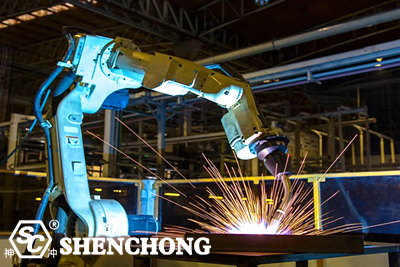
Industrial welding robots refer to robots that use computers for program control to perform welding tasks completely according to predetermined programs. They can replace traditional manual operations and achieve continuous, efficient, and intelligent production. These robots are typically equipped with precision sensors and welding equipment, capable of automatically performing welding tasks without human intervention.
According to the definition of non-standard custom welding robots by the International Organization for Standardization (ISO), industrial robots are multifunctional, reprogrammable automatic control robotic arms with three or more programmable axes, used in the field of industrial automation.
In order to adapt to different applications, the mechanical interface of the last axis of the robot is usually a connecting flange that can be connected to different tools or end effectors. Welding robots are equipped with welding tongs or welding (cutting) guns on the end shaft flanges of industrial robots for welding, cutting, or thermal spraying.
1) Suitable for welding in large format spaces. The intelligent operation of robots is flexible and reliable. It can be linked with six axes and can be welded in any space, not limited to flat welding.
2) Customers can customize fixtures according to production requirements.
3) It can achieve dual station or multi station welding operations, saving time for product installation fixtures and greatly improving production efficiency.
4) Combined with the first swing welding head in China, its unique wedge-shaped vibration method widens the weld seam, making laser welding more widely used. Efficient and precise laser welding of large workpieces and wide welds can be achieved. The welding quality effect is significantly better than that of ordinary welding joints. The surface of the weld seam is smooth and beautiful, and the welding quality is good.
5) High repeatability, repeatable welding, no material consumption, flexible processing, and low operating costs.
6) Some places can replace manual operation and are suitable for difficult space welding.
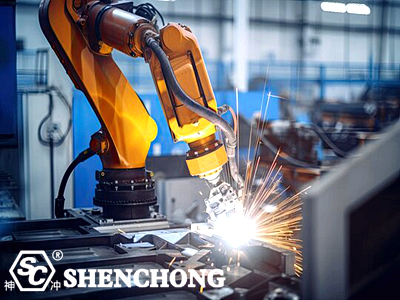
Industrial welding robots automatic welding technology can ensure that the position, shape, depth, width, and other parameters of each weld seam are constant, avoiding errors and unevenness in manual operation. At the same time, robot automatic welding technology can monitor and adjust factors such as current, voltage, speed, and temperature during the welding process in real time through sensors, cameras, and other devices to adapt to different workpiece materials and environmental conditions, ensuring the quality and strength of the weld seam.
Robot automatic welding technology can greatly improve welding speed and efficiency, reduce non productive time such as gun changing, wire changing, cleaning, etc. Robot automatic welding technology can also achieve collaborative work among multiple robots, simultaneously welding multiple workstations or parts, improving the flexibility and utilization of the production line.
Welding is a potentially hazardous job as it involves high temperatures and harmful gases. Robot automatic welding technology can keep personnel away from dangerous welding environments and reduce the risk of workplace accidents.
This is crucial for protecting the safety and health of workers, and also helps to reduce the company's legal responsibility. At the same time, robot automatic welding technology can reduce the requirements for worker operation skills, decrease training and management costs, and save human resources.
Due to the more precise control of the welding process by robot welding, material waste can be reduced. In addition, robots can precisely control the input of energy during welding, thereby reducing energy consumption. This is not only beneficial to the environment, but also helps to reduce production costs.
Robot automatic welding technology can change or adjust welding programs and parameters through software programming to adapt to workpieces of different specifications and shapes, without the need to replace or adjust hardware equipment, improving the versatility and adaptability of the equipment. This can shorten the preparation period for product modification and upgrade, improve market response speed, and also reduce corresponding equipment investment.
Robot automatic welding technology can adapt to various welding applications. It can be used for welding different types of materials, including steel, aluminum, stainless steel, and copper. In addition, robots can perform various types of welding, including spot welding, arc welding, and laser welding. This adaptability makes it widely used in various industries.
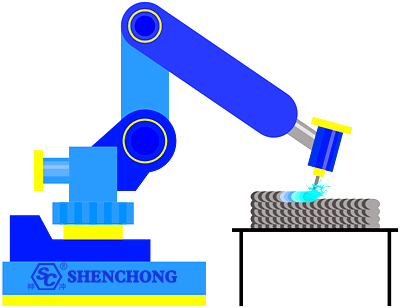
Industrial welding robots automatic welding technology has been widely applied in various fields, and the following is a brief introduction to some of the main areas:
Mechanical manufacturing is one of the earliest and most widely used fields of robot automatic welding technology, involving the connection of various types and scales of metal structural components, pipelines, containers, frames, and other parts.
Robot automatic welding technology can achieve precise and rapid welding of complex shapes, large sizes, heavy weights, and other workpieces, improving the quality and efficiency of mechanical manufacturing.
Automobile manufacturing is one of the important application areas of robot automatic welding technology, mainly used for welding parts such as automobile body, chassis, engine, gearbox, etc. Robot automatic welding technology can achieve high-speed, high-quality, and high-precision welding of automotive components, ensuring the performance and safety of automobiles.
At the same time, robot automatic welding technology can flexibly adjust welding programs and parameters according to different car styles and needs, improving the flexibility and adaptability of automobile manufacturing.
Aerospace is one of the high-end application fields of robot automatic welding technology, mainly used for welding components such as aircraft, rockets, satellites, etc. Robot automatic welding technology can achieve welding of aerospace equipment in extreme environments such as high strength, high temperature, and high pressure, ensuring the performance and safety of aerospace equipment.
At the same time, robot automatic welding technology can also meet the design requirements of lightweight, composite, and intelligent aerospace equipment, improving the level and competitiveness of aerospace equipment.
Electronic devices are one of the emerging application areas of robot automatic welding technology, mainly used for welding small and precise components such as electronic components, circuit boards, connectors, etc. Robot automatic welding technology can achieve special welding methods such as micro welding, laser welding, ultrasonic welding, etc. for electronic devices, ensuring the performance and reliability of electronic devices.
At the same time, robot automatic welding technology can also achieve welding of various materials and multi-layer structures of electronic devices, improving the functionality and complexity of electronic devices.
The manufacturing of medical equipment requires very high welding quality, as they may directly affect the patient's life. Robot automatic welding technology is used to manufacture surgical instruments, medical devices, and medical equipment, ensuring their reliability and hygiene.
In the energy industry, robot automatic welding technology is used to manufacture oil and gas pipelines, nuclear power plant components, and wind power equipment. These fields have extremely high requirements for welding quality and durability.
With the continuous development of artificial intelligence technology, welding robots will become increasingly intelligent and able to better adapt to different work environments and tasks.
Future welding robots will be more flexible, able to adapt to more materials and processes, and meet the needs of different customers.
Future welding robots will be more collaborative, working together with human workers to improve production efficiency and quality.
With the continuous development of IoT technology, future welding robots will also achieve remote control, helping enterprises better manage and monitor the production process.
The advantage of robot automatic welding technology lies in improving welding quality, production efficiency, and work safety. It has been successfully applied in various fields, including manufacturing, automotive manufacturing, aerospace, electronics manufacturing, medical equipment manufacturing, and energy industry.
With the continuous development of technology, we can foresee that industrial welding robots technology will continue to expand its application scope and play a greater role in the future manufacturing field. If you want to improve production efficiency, reduce costs, and enhance product quality, you may consider introducing robot automatic welding technology to meet your production needs.