+86-158-9507-5134
info@shenchong.com
 EN
EN

Compared to ordinary carbon steel, stainless steel plate rolling places higher demands on equipment rigidity, roll precision, material condition, rolling processes, springback control, and operator experience. Stainless steel is characterized by high strength, significant work-hardening properties, and a strong tendency for springback. Inadequate process control can easily lead to issues such as poor roundness, diameter deviations, tapering, excessively long straight edges at the ends, surface scratches, localized indentations, weld misalignment, and uneven forming.
This is particularly critical in the manufacture of pressure vessels, chemical processing equipment, food machinery, pharmaceutical equipment, storage tanks, piping, and decorative stainless steel products; rolling quality affects not only dimensional accuracy but also subsequent welding, assembly, and the final appearance of the product.
The following is a systematic analysis covering various aspects, including materials, equipment, rolls, process parameters, pre-bending, the rolling process, springback control, weld seams, surface protection, inspection, and equipment maintenance.
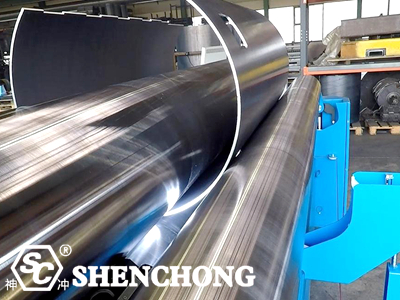
First, let's understand why stainless steel plate is harder to roll.
Compared to common carbon steels like Q235, rolling stainless steel presents several specific challenges:
For common grades like 304 and 316L, actual material properties are influenced by the specific grade, thickness, and processing state (cold-rolled vs. hot-rolled).
For the same thickness and width:
Stainless steel typically requires greater rolling force and higher pre-bending capacity.
Consequently, if the equipment lacks sufficient tonnage, roll diameter, or rigidity, the following issues are likely to occur:
- Inability to roll the material
- Plate slippage
- Excessive diameter
- Poor roundness
Inconsistent forming between the center and the ends.
This is a critical issue to consider when rolling stainless steel.
Stainless steel undergoes work hardening after plastic deformation occurs.
Simply put:
After the initial bend, the material becomes locally more resistant to further deformation.
If the operation involves repeated small adjustments rather than a proper continuous forming process, it can lead to:
- Localized hardening
- Constantly increasing rolling force
- Variations in local springback
- Inconsistent roundness
Visible surface marks from the hardening process.
Stainless steel plate exhibits a certain degree of elastic recovery after the rolling load is released.
Therefore:
The shape observed on the machine ≠ the final shape in the free state.
For example:
If the target diameter is 1000 mm and the plate is rolled directly to that final diameter, the actual diameter may end up being larger after unloading.
Thus, compensation for material springback must be factored into the rolling process.
The first step in improving stainless steel rolling quality is selecting the right equipment.
The equipment serves as the foundation for rolling precision.
For stainless steel plates, the following are recommended:
- Four-roll plate bending machine
- High-rigidity three-roll plate bending machine
- CNC four-roll plate bending machine
- Hydraulic four-roll plate bending machine
If the production task demands high standards for roundness, repeatability, and mass production efficiency, a four-roll plate bending machine is usually the better choice.
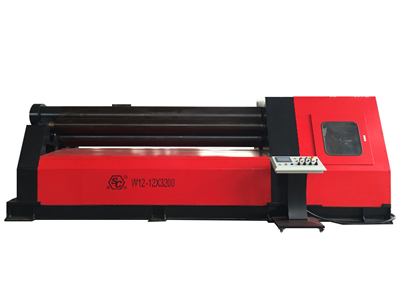
A four-roll plate bending machine typically includes:
- Top roll
- Bottom roll
- Left side roll
- Right side roll
Its advantage lies in the ability to clamp and position the plate using the bottom and side rolls.
Stainless steel plates are prone to shifting during the rolling process.
The four-roll structure clamps the plate between the top and bottom rolls, ensuring greater positional stability.
Four-roll machines can perform edge pre-bending directly during the rolling process.
This is crucial for minimizing the length of unbent straight edges.
The following parameters can be program-controlled:
- Top roll position
- Bottom roll position
- Left side roll position
- Right side roll position
- Rolling speed
- Number of rolling passes
This makes it more suitable for mass production.
Equipment rigidity is critical—a factor often overlooked by many users.
For example, consider a 20×3000 mm stainless steel plate:
Theoretically, a specific machine might have the capacity to roll it, but that does not guarantee it can maintain high precision over the long term.
Key areas to focus on include:
If the frame undergoes significant deformation, it leads to:
- Shifts in the roll centerlines
- Uneven pressure on the two sides of the plate
- Inconsistent rolling radii between the center and the edges
Ultimately resulting in:
A round shape in the middle but non-round shapes at the ends.
If the roll diameter is too small or rigidity is insufficient, deflection is likely to occur during rolling.
Typical manifestation:
The ends of the plate meet the requirements, but the middle section is insufficiently rolled. Therefore, the rolling of heavy-duty stainless steel requires particular attention to the following:
Roll diameter + roll length + roll material + roll heat treatment + stand rigidity.
The roll diameter directly affects:
- Minimum rolling diameter
- Rolling force
- Plate deformation
- Roll deflection
- Rolling stability
Generally speaking:
Provided the minimum rolling diameter requirement is met, increasing the roll diameter appropriately helps improve overall rigidity.
However, bigger is not necessarily better.
An excessively large roll diameter may lead to:
- An increase in the minimum rolling diameter
- Difficulty in rolling small-diameter cylinders
- Increased energy consumption
Therefore, the selection should be based on a comprehensive assessment of:
Maximum thickness + Maximum width + Minimum rolling diameter + Material strength
Do not assume that a plate is ready for immediate rolling simply because it meets standard specifications.
At a minimum, check the following items before rolling:
Verify that the actual thickness matches the design value.
Pay particular attention to plates with thicknesses of:
6 mm
8 mm
10 mm
12 mm
16 mm
20 mm or greater
Variations in actual thickness will affect the final rolled diameter.
If the raw plate exhibits:
- Waviness
- Center bulge (crown)
- Edge waves
- Localized warping
Defects such as the following are likely to occur after rolling:
- Ovality (out-of-roundness)
- Localized bumps or depressions
- Circumferential errors
Some stainless steel plates exhibit significant differences based on rolling direction.
For products requiring high precision, it is recommended to standardize the material orientation and conduct process validation.
This is particularly important for stainless steel.
Stainless steel surfaces are highly susceptible to scratches caused by:
- Iron filings
- Weld spatter
- Metal dust
- Oil/grease
- Dust
Therefore, before rolling, you should:
- Clean the worktable
- Clean the rollers
- Remove foreign matter from roller surfaces
- Inspect the sheet surface
- Prevent contamination from carbon steel dust
Pay special attention to the following:
Ideally, avoid processing stainless steel in areas shared with ordinary carbon steel.
Otherwise, iron contamination may lead to rust spots appearing on the surface later.
Standard rolling operations can easily scratch mirror-finish stainless steel, brushed stainless steel, and decorative panels.
Consider using:
- Polyurethane protective layers
- Nylon protective films
- Specialized protective pads
- Rollers dedicated to stainless steel
- Surface protective films for the sheets
However, note the following:
Protective materials must not compromise the sheet clamping force or rolling stability.
For high-end decorative stainless steel, it is recommended to maintain surface protection throughout the entire process, starting from the moment the material enters the workshop.
Many people focus solely on the rolling diameter but neglect the straightness of the plate across its width.
If the rolls deflect significantly, a conical shape may result instead of the ideal straight cylindrical shape.
This often indicates:
- Insufficient roll rigidity
- Uneven pressure distribution
- Uneven plate thickness
- Improper equipment leveling
The geometric relationship between the top, bottom, and side rolls is crucial.
If there are errors in parallelism:
- Deformation varies between the left and right sides
- The plate tends to drift
- The cylinder develops a taper
- Weld misalignment increases
Therefore, roll parallelism calibration is essential during the equipment installation and commissioning phase.
Equipment leveling is equally important.
An unstable foundation or settling after long-term use can lead to:
- Frame deformation
- Roll center misalignment
- Uneven force distribution (left vs. right)
- Reduced product precision
Therefore, regular checks are recommended for:
- The foundation
- Anchor bolts
- The frame
- Leveling status
- Roll centerlines
The stability of the hydraulic system affects rolling quality.
For hydraulic plate rolling machines, particular attention should be paid to:
- Hydraulic oil cleanliness
- Hydraulic pressure stability
- Hydraulic cylinder synchronization
- Seal condition
- Hydraulic valve response
- Pipeline leaks
Uneven pressure between the left and right hydraulic cylinders can lead to inconsistent positioning of the left and right side rolls.
This directly affects roundness and taper.
Synchronization control is critical.
Modern hydraulic four-roll plate rolling machines achieve synchronization of the left and right side rolls through:
- Displacement sensors
- Encoders
- Proportional valves
- CNC control systems
This improves:
- Positioning accuracy
- Repeatability
- Left-right consistency
- Product stability
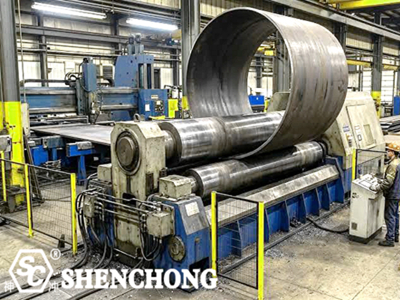
Pre-bending is a vital step in determining the final roundness.
If the ends are not sufficiently pre-bent, noticeable straight edges will remain.
Theoretically, to form a perfect cylinder, insufficient pre-bending at the ends often results in distinct flat sections.
Because stainless steel possesses high resistance to deformation and significant springback.
If pre-bending is inadequate:
- The ends fail to achieve the required curvature
- The middle section approaches the target roundness
- Straight edges persist at the ends during continued rolling
- Repeated adjustments become necessary
This not only reduces efficiency but also increases the risk of localized work hardening.
A "pre-bending – rolling – rounding" process is recommended.
For stainless steel cylinders with strict requirements, the following approach can be used:
Form the target curvature at both ends of the plate beforehand.
Gradually form the arc by continuously adjusting the position of the side or bottom rolls.
Bring the two ends gradually together.
Make minor adjustments based on actual measurements.
This is a very common error in actual production.
To boost efficiency, some operators apply heavy pressure immediately and roll rapidly.
This method is not ideal for stainless steel.
It can easily lead to:
- Excessive localized plastic deformation
- Work hardening
- Increased load on the rolls
- Plate slippage
- Uneven roundness
- Surface indentations
A more rational approach is to increase the degree of deformation gradually.
Multi-pass rolling can be employed for thick stainless steel plates.
For example:
Positioning → Pre-bending → First rolling pass → Second rolling pass → Third correction pass → Rounding
This ensures more uniform deformation.
However, note that "multi-pass" does not mean endless, repetitive adjustments.
Stainless steel is prone to significant work hardening, so unnecessary repetitive loading should be minimized.
Rolling speed also affects quality.
Excessive speed may result in:
- Poor plate responsiveness
- Delayed operational response
- Increased adjustment errors
- Unstable plate positioning
Conversely, excessively slow speed may:
- Reduce production efficiency
- Increase production costs
Therefore, the appropriate speed should be selected based on:
Plate thickness + Material type + Plate width + Coil diameter + Equipment capabilities
This is a crucial factor in ensuring the cylinder does not develop a taper.
If:
Left roll height ≠ Right roll height
It can lead to uneven deformation on the two sides of the plate.
The final result is:
A larger diameter at one end and a smaller diameter at the other.
This is commonly known as: taper.
Therefore, CNC plate rolling machines should use position sensors and synchronous control to ensure the left and right side rolls remain aligned.
If the plate shifts laterally during the rolling process, it can cause:
- Uneven dimensions at the ends
- End misalignment
- Skewed cylinder axis
- Misalignment of weld seams
Therefore, during loading, the plate's centerline should be aligned with the equipment's centerline as much as possible.
If necessary, use:
- Lateral positioning devices
- Laser alignment systems
- Mechanical stops
- CNC positioning systems
If high product consistency is required, CNC control is recommended.
CNC plate rolling machines can record:
- Material thickness
- Material width
- Material strength
- Rolling diameter
- Roll positions
- Rolling programs
- Pass parameters
This enables:
Rapid parameter recall for repeat production of the same specifications.
It is particularly suitable for batch production.
Dimensional inspection is mandatory after rolling. Do not rely solely on visual inspection to judge roundness.
Recommended tools include:
Suitable for simple diameter measurements.
Suitable for high-precision inspection.
Suitable for large cylinders.
Suitable for high-precision manufacturing.
Suitable for quick on-site checks. Focus on inspecting the following dimensions:
① Outer diameter
② Roundness
③ Taper
④ Ovality
⑤ End straight edge
⑥ Weld misalignment
⑦ Straightness of the cylinder axis
⑧ Surface quality
Springback compensation is key to achieving high precision. In the precision control of stainless steel rolling, springback cannot be completely eliminated.
Therefore, one cannot simply assume:
Target Diameter = Equipment Setting Diameter.
Instead, one should establish the relationship:
Equipent Setting → Material Deformation → Unloading/Springback → Final Dimensions.
Establishing springback correction values through trial rolling:
Example: Target: φ1000 mm
Measurement after first pass: φ1015 mm
This indicates significant springback.
For the next batch, the amount of rolling deformation can be appropriately increased.
Through repeated trials, one can gradually determine:
304 × 10 mm → φ1000 mm → A specific set of roller position parameters.
These settings can then be recalled directly for future use.
This approach is more consistent than relying solely on operator experience.
Do not assess final precision immediately after rolling.
Due to material springback, it is recommended to perform final dimensional inspection only after the workpiece has stabilized.
This is particularly important for:
- Thick plates
- High-strength stainless steel
- Large-diameter cylinders
The timing of the inspection should be determined based on process requirements.
Surface quality control is equally important.
For stainless steel products, dimensional accuracy is only one aspect of quality; surface quality is just as critical.
Especially for:
- Food processing machinery
- Medical equipment
- Pharmaceutical equipment
- Kitchen equipment
- Architectural decoration projects
Users are often very sensitive to surface scratches.
Therefore, the following measures are recommended:
Raw material protection: Use protective film.
Roller protection: Keep rollers clean and smooth.
Workstation protection: Prevent iron filings from entering the processing area.
Handling protection: Use soft lifting slings, nylon lifting gear, etc.
Do not allow ordinary steel wire ropes to come into direct contact with high-end stainless steel surfaces.
Direct contact between steel wire ropes and stainless steel can cause:
- Scratches
- Indentations
- Iron contamination
It is preferable to use:
- Nylon slings
- Specialized clamps
- Rubber protective pads
- Lifting tools designed specifically for stainless steel
Parameters cannot be identical for plates of different thicknesses.
For example:
Key focus areas:
- Surface protection
- Plate stability
- Roll gap
- Prevention of localized indentation
Key focus areas:
- Rolling force
- Pre-bending capability
- Springback
- Roll rigidity
Key focus areas:
- Equipment rated capacity
- Roll strength
- Hydraulic system
- Pre-bending capability
- Multi-pass process
- Control of plate temperature and deformation
If the above information were condensed into the most practical principles for the production floor, they could be summarized as follows:
1) Select a plate rolling machine with sufficient rigidity
Do not look only at maximum thickness; also consider:
Material strength + plate width + minimum rolling diameter + roll rigidity.
2) Ensure roll precision
Check:
- Radial runout
- Parallelism
- Centerline alignment
- Surface quality
3) Ensure equipment leveling
Regularly inspect the condition of the foundation and machine frame.
4) Strictly perform edge pre-bending
Minimize flat ends and improve final roundness.
5) Control synchronization of side rolls (left and right)
Prevent tapering.
6) Employ a rational multi-pass rolling process
Avoid excessive deformation in a single pass.
7) Establish a springback compensation database
Convert experience into standardized processes.
8) Protect the stainless steel surface throughout the process
Prevent scratches and iron contamination.
9) Utilize CNC rolling
Improve repeatability.
10) Conduct quantitative inspection after rolling
Do not rely solely on visual assessment.
A comprehensive production workflow can be outlined as follows:
Raw material inspection
↓
Verification of material grade/thickness/width
↓
Plate surface cleaning
↓
Rolling machine precision check
↓
Roller cleaning and protection
↓
Plate centering
↓
Edge pre-bending
↓
First rolling pass
↓
Second rolling pass
↓
Gradual closing
↓
Roundness inspection
↓
Springback correction
↓
Rounding calibration
↓
Diameter/roundness/taper inspection
↓
Surface quality inspection
↓
Proceed to welding/subsequent processing
Key focus areas:
- Frame rigidity
- Roller precision
- Hydraulic system
- Synchronization control
- CNC system
- Position sensing
Key focus areas:
- Material
- Pre-bending
- Rolling passes
- Roller positioning
- Rolling speed
- Springback compensation
- Rounding calibration
Key focus areas:
- Outer diameter
- Roundness
- Taper
- Ovality
- Straight edge
- Surface quality
- Weld misalignment
Truly consistent rolling quality is, in essence, the result of the combined interaction of:
Equipment precision × Process parameters × Operational standards × Inspection feedback
If a company primarily processes stainless steel, I recommend looking beyond the manufacturer's specified:
"Maximum plate rolling thickness."
You should also specifically inquire about the following parameters:
- Item Key Focus Areas
- Maximum rolling thickness Actual stainless steel processing capacity
- Maximum rolling width Compliance with product dimensions
- Minimum rolling diameter Compliance with product specifications
- Material strength Calculations based on stainless steel properties
- Top roll diameter Impact on rigidity and minimum bending diameter
- Bottom roll diameter Impact on load-bearing capacity
- Side roll diameter Impact on pre-bending and forming
- Roll material Strength and wear resistance
- Frame rigidity Critical factors for heavy-duty rolling
- Hydraulic system Stability
- Synchronization control Left-right symmetry
- CNC system Parameter repeatability
- Pre-bending capability Minimizing straight edges
- Rounding function Final dimensional accuracy
- Conical rolling Special product requirements
- Automatic loading and unloading Considerations for high-volume production
Improving the precision and quality of stainless steel plate rolling cannot be achieved simply by "calibrating the rolling machine". Rather, it requires a comprehensive process system.
This can be summarized as follows:
Material stability → Equipment rigidity → Roll precision → Accurate positioning → Sufficient pre-bending → Uniform rolling → Springback compensation → Surface protection → Quantitative inspection → Parameter accumulation.
For standard stainless steel products, the primary focus is on:
Roundness, diameter, and taper.
For high-end stainless steel products, additional requirements must be met:
Dimensional accuracy + Roundness + Welding quality + Surface quality + Batch consistency.
For heavy-duty applications such as pressure vessels, chemical equipment, and large storage tanks, standardized processes must be established regarding machine rigidity, roll deflection compensation, hydraulic synchronization, pre-bending capability, CNC control, and end-to-end inspection.
If an enterprise can establish a standard workflow comprising "trial rolling—measurement—correction—recording—parameter recall," it can transition from relying on the experience of veteran operators to a digital, standardized, and repeatable rolling production model—even when handling various stainless steel grades like 304 and 316.