+86-158-9507-5134
info@shenchong.com
 EN
EN

Fiber laser cutting process is a widely used high-precision thermal cutting technology in the processing of metal sheets, pipes, and profiles. It utilizes a fiber laser to generate a high-energy-density laser beam, which, after being focused by an optical system, concentrates the energy onto a very small area of the material surface. This causes the metal to rapidly melt, vaporize, or form a high-temperature molten layer. Then, an auxiliary gas is used to blow away the molten material, thus creating a continuous and precise kerf.
The entire process can be summarized as follows:
Laser generation → Fiber transmission → Beam collimation → Focusing → Material energy absorption → Melting/vaporization → Auxiliary gas slag removal → Laser head movement → Kerf formation → Part processing completed.
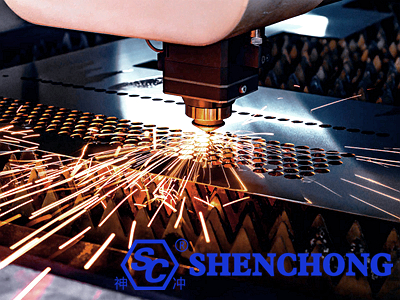
A fiber laser cutting machine is a CNC machining equipment that uses a fiber laser as the laser source to cut metal materials.
A typical system includes:
- Fiber laser
- Laser transmission system
- Laser cutting head
- Focusing lens
- - Collimation system
- Nozzle
- Assistant gas system
- CNC system
- X/Y/Z motion mechanism
- Worktable
- Chiller
- Electrical control system
- Fumigation and dust removal system
Compared to traditional mechanical shearing, plasma cutting, and flame cutting, the biggest advantages of fiber laser cutting are: non-contact operation, high energy density, high precision, narrow kerf, small heat-affected zone, and high degree of automation.
Fiber laser cutting is essentially a process of converting laser energy into thermal energy in the material to achieve localized material removal.
It can be simply understood as:
Concentrating a large amount of laser energy onto a very small point, causing the metal to instantly reach its melting point or even boiling point, and then using an assist gas to remove the molten metal.
For example, cutting ordinary carbon steel:
Laser beam → Metal absorbs the laser → Local temperature rises rapidly → Material melts → Oxygen participates in the reaction → Molten oxides are produced → High-pressure oxygen blows out the slag → A kerf is formed.
When cutting stainless steel with nitrogen, the melting is mainly achieved through laser, and then high-pressure nitrogen removes the molten metal, reducing oxidation.
This is the core of the entire system.
Fiber lasers typically use Yb-doped fiber as the gain medium and are powered by a semiconductor laser pump source.
Basic process:
The semiconductor laser diode inside the laser generates pump light.
After entering the ytterbium-doped fiber, the pump light causes energy level transitions in the rare-earth ions.
Photons continuously stimulate other excited-state particles to produce photons with the same characteristics.
These photons possess the following characteristics:
- Same or similar frequencies
- Good coherence
- High directionality
- High energy density
Laser feedback is formed through gratings, reflective structures, etc., continuously amplifying the light.
Ultimately, this results in the high-power laser required for industrial cutting.
Traditional CO₂ lasers require large gas laser cavities, while fiber lasers primarily transmit and amplify laser light through optical fibers.
A typical structure can be understood as follows:
Pump source
↓
Ytterbium-doped fiber
↓
Laser generation
↓
Fiber amplification
↓
Output laser
↓
Laser cutting head
This structure allows fiber lasers to achieve high photoelectric conversion efficiency while maintaining a more compact device structure.
The laser light generated by the fiber laser is first transmitted through optical fibers.
Compared to traditional free-space optical paths, fiber transmission offers the following advantages:
- Stable optical path
- Compact structure
- Low energy loss
- Easy installation
- Relatively simple maintenance
The laser light ultimately enters the laser cutting head.
The laser cutting head is a crucial component of a fiber laser cutting system.
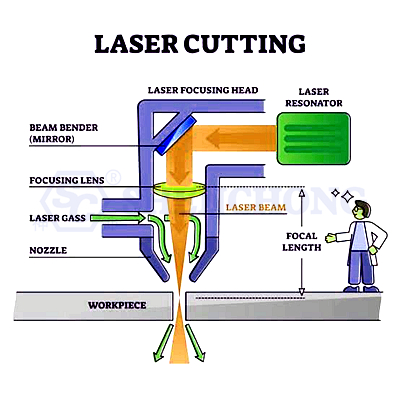
The laser cutting head is primarily responsible for:
- Laser collimation
- Laser focusing
- Focus position control
- Auxiliary gas delivery
- Nozzle control
- Height following
- Anti-collision protection
After entering the cutting head, the laser beam first passes through the collimating lens.
This converts the diverging beam from the fiber into a more regular, parallel beam.
Then it enters:
The focusing lens concentrates the laser beam into a very small focal point.
The energy density in the focal region is extremely high.
Therefore, it can rapidly heat materials within a very small area.
The key lies in energy density.
Laser power itself is not the only factor determining cutting ability.
More importantly, it's the laser power density per unit area.
For example: A 1000W laser applied to a large area might only heat the surface.
However, if 1000W of energy is concentrated into an area of tens of micrometers or even smaller using an optical system, the energy density per unit area becomes extremely high.
Therefore, the metal can be rapidly brought to:
- Melting temperature
- Vaporization temperature
- Even forming a localized plasma state
The following is an analysis according to the actual processing sequence.
Engineers first design the parts using software such as CAD, SolidWorks, and AutoCAD.
For example:
Part drawing
↓
Dimensions
↓
Hole positions
↓
Outline
↓
Quantity
Multiple parts are arranged onto a single sheet of material.
This process is called: Nesting
The main purposes are:
- Improving material utilization
- Reducing waste
- Shortening the cutting path
- Improving production efficiency
CAM software generates a laser cutting program based on the part's contour.
The program typically includes:
- Cutting path
- Laser power
- Cutting speed
- Drilling parameters
- Assist gas
- Gas pressure
- Focus position
- Acceleration/deceleration parameters
After the sheet metal is placed on the worktable, the CNC system controls the laser head to move to the designated position.
At this time, the laser head typically performs:
Positioning → Height detection → Automatic focusing → Drilling
The height following system detects the distance between the nozzle and the sheet metal.
If there is some deformation on the sheet metal surface, the laser head can automatically adjust its Z-axis position based on the height sensor signal.
Before the actual cutting, the laser must first create a starting hole on the sheet metal.
This is Piercing
Typical Process:
Laser Output
↓
Rapid Local Heating
↓
Metal Melting
↓
Formation of Molten Pool
↓
Molten Material Discharge
↓
Formation of Through Hole
↓
Start Cutting
Piercing is especially important for thick plates.
If the piercing parameters are not set properly, the following may occur:
- Excessive Piercing Time
- Surface Ablation
- Nozzle Contamination
- Lens Contamination
- Piercing Failure
- Laser Head Damage
After piercing, the laser head moves according to the NC program.
For example:
Starting Point
↓
Straight Line
↓
Arc
↓
Hole
↓
Curve
↓
Outer Contour
↓
End Point
The laser continues to act on the material.
A molten pool rapidly forms in the laser-acting area.
Simultaneously, auxiliary gas is ejected at high speed from the nozzle.
This is a crucial step in laser cutting.
Common assist gases include:
Mainly used for: Carbon steel cutting
Oxygen not only blows away molten metal but also participates in the oxidation reaction.
Therefore:
Laser energy + heat of oxidation reaction
Work together to complete the cut.
Mainly used for:
- Stainless steel
- Aluminum
- Copper
- Brass
Materials requiring high surface quality
Nitrogen typically does not participate in significant oxidation reactions.
Therefore, a cleaner cut edge can be obtained.
Suitable for:
- Ordinary carbon steel sheets
- Stainless steel sheets
- Aluminum sheets
- Cost-sensitive processing
The advantage is lower cost.
However, the final result is closely related to the material, thickness, laser power, and process parameters.
The laser cutting area can be divided into several regions:
- Laser beam
- Molten pool
- High-pressure assist gas
- Sheet material
The laser first rapidly raises the material temperature.
The following occurs:
The metal surface absorbs laser energy.
The local temperature rises rapidly.
The material reaches its melting point, forming molten metal.
Some material further vaporizes.
High-pressure auxiliary gas blows the molten material away from the kerf.
After cutting, the area near the kerf cools rapidly.
The final result is: Kerf
When selecting laser cutting equipment, it is recommended to focus on the following:
For example:
1.5kW
3kW
6kW
12kW
20kW
30kW
Higher Power
Common:
3015
4020
4020
6020
6025
6020
8025, etc.
Actual models may vary depending on the manufacturer's definition.
Impact:
- Hole Position
- Part Size
- Assembly Accuracy
Especially important for mass production.
Determines the dynamic efficiency when processing complex parts.
Impact: Non-cutting travel time.
Industrial fiber laser cutting typically operates in the near-infrared band.
After cutting, quality is typically assessed from the following aspects:
A more uniform cut surface generally indicates better matching of process parameters.
Observe whether molten slag is present at the bottom of the cut.
Is the cut surface nearly perpendicular?
Observe whether there is obvious discoloration or overheating at the material edges.
Is the kerf stable?
Especially for small and precision holes.
Check whether the final dimensions of the part meet the drawing requirements.
The complete production process can be summarized as follows:
CAD Design
↓
CAM Programming
↓
Automatic Nesting
↓
NC Program Generation
↓
Sheet Material Loading
↓
Equipment Zeroing
↓
Sheet Material Positioning
↓
Height Detection
↓
Laser Head Focusing
↓
Drilling
↓
Lead-in Line
↓
Formal Cutting
↓
Auxiliary Gas Slag Removal
↓
Contour Completion
↓
Part Separation
↓
Processing Completion
↓
Unloading/Sorting
If further integrated with automation, it can form:
Intelligent Warehousing → Automatic Loading → Laser Cutting → Automatic Sorting → Bending → Welding → Finished Product Warehousing
This is also an important production mode in modern intelligent sheet metal factories.
Suitable for precision sheet metal processing.
Especially suitable for mass production of thin and medium-thick sheets.
No need to create dedicated tools for each contour.
It can connect with:
Automatic loading and unloading, intelligent warehousing, automated sorting, robots, MES, ERP.
Intelligent nesting can improve the utilization rate of sheet metal.
It can process:
Carbon steel, stainless steel, aluminum, copper, brass, galvanized sheet, and some special metal materials.
Modern fiber laser cutting process is no longer just a "cutting machine."
It is gradually becoming a processing node in intelligent sheet metal production lines:
Intelligent Sheet Metal Warehouse
↓
Automatic Material Identification
↓
Automatic Loading
↓
Fiber Laser Cutting
↓
Automatic Unloading
↓
Robot Sorting
↓
Bending
↓
Robot Welding
↓
Surface Treatment
↓
Finished Product
Therefore, when evaluating a modern fiber laser cutting machine, in addition to considering laser power, one should also focus on the overall capabilities of:
Laser + Cutting Head + CNC System + Motion Platform + Automatic Focusing + Gas Path + Nesting Software + Loading/Unloading + Intelligent Warehousing + Data Management.
The essence of fiber laser cutting process is to use a high-energy-density laser beam to rapidly heat a localized area of metal to a molten or vaporized state, while simultaneously using auxiliary gas to expel the molten material. The CNC system then precisely controls the movement of the laser head to obtain the desired two-dimensional or three-dimensional cutting contour.
If we break down the working principle of the equipment further, the most crucial aspects are the five links: "energy generation by the laser, energy focusing by the optical system, energy absorption by the material, exhaust of the molten material by the auxiliary gas, and trajectory control by the CNC system".