+86-158-9507-5134
info@shenchong.com
 EN
EN
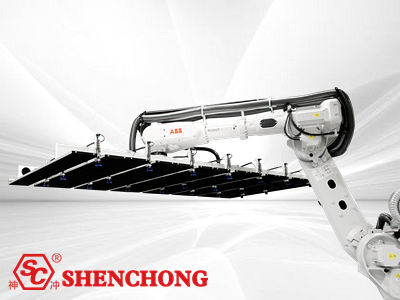
Robotic automated loading and unloading is an important component of modern metal processing automation, widely used in laser cutting, punching machines, shearing machines, press brake bending machines, rolling machines, machining centers, and sheet metal production lines. Its core function is to utilize industrial robots, gantry robots, or dedicated automatic loading and unloading mechanisms to complete raw material picking, positioning, handling, loading, unloading, stacking, and inter-process transfer, thereby reducing manual handling and improving production efficiency and stability.
For sheet metal companies, automated loading and unloading by robots is not just about "replacing manual labor with robots to move things," but rather an important foundation for achieving equipment automation, continuous production, intelligent logistics, and digital production.
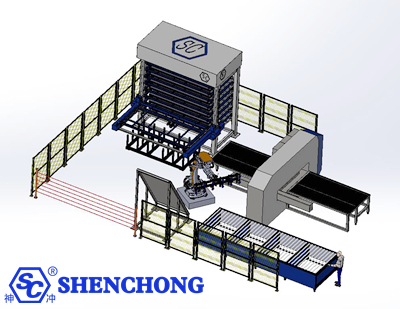
A typical robotic automated loading and unloading system consists of the following components:
- Industrial robot or gantry robot
- Robot control cabinet
- Robot end effector
- Vacuum or electromagnetic chuck
- Grippers/robotic arms
- Positioning table
- Loading rack
- Unloading rack
- Finished product palletizing area
- Safety fence and safety gate
- Photoelectric sensors
- Anti-collision device
- PLC control system
- Communication system with host equipment
- Interface with MES/ERP and other production management systems
The basic workflow can be understood as:
Raw material storage → Automatic picking → Identification/positioning → Loading → Host processing → Automatic part picking → Unloading → Sorting → Palletizing → Next process
For example, on a fiber laser cutting production line:
Sheet material warehouse → Robot picks up sheet material → Automatic positioning → Places on laser cutting machine → Cutting completed → Robot picks up finished product → Sorting → Palletizing
Further integration with intelligent warehousing systems, AGVs, and MES systems can form a complete automated production logistics system.
In traditional production models, operators are required to perform the following tasks:
- Handling raw materials
- Placing sheets on the equipment
- Adjusting positions
- Starting the equipment
- Retrieving finished products after processing
- Handling finished products
- Sorting and palletizing
Robotic automated loading and unloading systems can automate many of these repetitive tasks.
This means that businesses can upgrade from the traditional:
Manual handling + Manual operation + Manual palletizing
to:
Automatic material handling + Automatic loading + Automatic processing + Automatic unloading + Automatic palletizing.
The value of automated loading and unloading is particularly evident for large, thick, and heavy metal sheets.
The stability of a robot's loading and unloading operations largely depends on its end effector.
Common types include:
Suitable for:
- Steel plates
- Stainless steel plates
- Aluminum plates
- Laser-cut sheets
Advantages:
- Less prone to damaging materials
- Large gripping area
- High degree of automation
Mainly suitable for:
- Ferromagnetic steel plates
Advantages:
- Fast gripping speed
- Relatively simple structure
- Suitable for steel plate handling
However, for:
- Aluminum plates
- Copper plates
- Non-magnetic materials in stainless steel
Other gripping solutions need to be selected based on material characteristics.
Suitable for:
- Profiles
- Pipes
- Processed parts
- Special workpieces
Advantages:
- Good gripping stability.
On complex production lines, a combination of:
Vacuum chucks + electromagnetic chucks + mechanical grippers can be used.
The system's flexibility is improved by automatically switching between different capture methods.
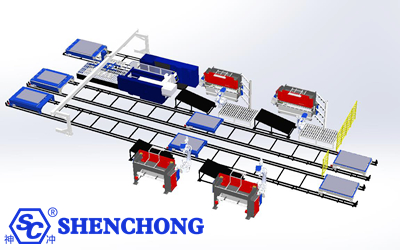
Manual loading and unloading often involves waiting time.
For example:
Operators need to move the sheet metal.
Sheet metal needs to be aligned.
Finished parts need to be retrieved.
Finished products need to be moved away.
The next sheet metal needs to be reloaded.
Robots can operate continuously according to preset programs, making loading and unloading actions more closely matched to the machine's processing rhythm.
Especially in continuous production environments such as laser cutting, stamping, bending, and machining, it can effectively reduce equipment waiting time.
The increase in production efficiency mainly comes from:
Reduced manual handling time + Shortened loading and unloading time + Reduced equipment idle time + Achieving continuous production.
This is one of the most direct advantages of robotic automated loading and unloading.
Metal sheets typically have the following characteristics:
- Heavy weight
- Large size
- Sharp edges
- Difficult to grip
- Difficult to handle
- High risk of injury during manual operation
For example, even if a large steel plate isn't at its maximum weight, manual handling can still result in:
- Waist injuries
- Hand injuries
- Plate slippage
- Edge scratches
- Collision with equipment
- Low efficiency in multi-person collaboration
When robots handle these repetitive handling tasks, personnel can transition from "handlers" to:
equipment operators, production managers, quality inspectors, and system maintenance personnel.
Automated robotic loading and unloading reduces direct human contact with hazardous areas.
In the metalworking industry, potential hazards include:
- Laser
- High-temperature workpieces
- Shearing blades
- Stamping areas
- Bending dies
- Heavy sheet metal
- High-speed motion mechanisms
- Mechanical fixtures
- Automated conveying equipment
Automated loading and unloading systems typically include:
- Safety fences
- Safety doors
- Safety light curtains
- Emergency stop buttons
- Collision avoidance systems
- Safety sensors
- Area detection systems
Robots enter hazardous areas to operate, while workers monitor and manage from relatively safe locations.
Automation does not mean safety measures can be eliminated. A complete robotic unit must undergo risk assessment and be designed, installed, and validated in accordance with the equipment manufacturer's and applicable local mechanical, electrical, and safety regulations.
Manual loading is prone to:
- Sheet material misalignment
- Angle error
- Inaccurate positioning
- Sheet material not fully aligned with the positioning reference
Robots, on the other hand, can move according to preset coordinates.
Through:
Robot coordinate system + positioning mechanism + sensors + vision system
More stable workpiece positioning can be achieved.
For laser cutting, the stability of the loading position directly affects subsequent processing.
For bending, workpiece positioning accuracy also affects:
- Bending position
- Bending angle
- Workpiece size
- Consistency across multiple processing steps
One of the biggest characteristics of manual operation is the presence of individual differences.
Different employees:
- Different operating speeds
- Different skill levels
- Different loading positions
- Different handling methods
- Different working states
Robots execute according to a unified program.
Therefore, this results in:
Unified actions → Unified cycle time → Unified positioning → Unified process.
This consistency is especially important for mass production.
Robots do not necessarily mean "completely eliminating the need for human intervention."
A more reasonable understanding is:
Use a small number of highly skilled personnel to manage automated equipment, rather than a large number of people performing repetitive handling tasks.
For example, a traditional production line might require:
- Loading personnel
- Unloading personnel
- Handling personnel
- Palletizing personnel
After automation, some positions can be combined into:
1 operator + automated loading/unloading system
Of course, the actual personnel configuration needs to be determined based on the number of equipment, production cycle time, material weight, workpiece complexity, and degree of automation.
Manual production is typically affected by:
- Working hours
- Fatigue level
- Shift changes
- Staff turnover
- Recruitment difficulty
Robots do not experience human fatigue due to long-term repetitive handling.
Therefore, they are very suitable for:
Two-shift, three-shift, and long-term continuous production.
This is especially important for high-utilization equipment such as laser cutting.
If the main equipment is expensive, increasing the effective operating time of the equipment can further improve the return on investment.
This is a key application scenario for automated robotic loading and unloading.
Typical Process:
Sheet metal storage → Automated sheet metal retrieval → Laser cutting → Finished product sorting → Palletizing.
The robot can perform:
- Sheet metal gripping
- Loading
- Finished product handling
- Parts sorting
- Scrap handling
- Classification and palletizing
When combined with an automated sheet metal warehouse, a complete system can be formed:
Intelligent sheet metal storage + laser cutting + automated loading and unloading + finished product sorting.
The stamping industry is characterized by:
- High cycle time
- High repeatability
- Large number of workpieces
- High risk of manual operation
The robot can perform:
Retrieval → Positioning → Loading → Stamping → Retrieval → Transfer → Next process.
Multiple machines can even form a continuous production line using robots.
For example:
Punch press 1 → Robot → Punch press 2 → Robot → Punch press 3 → Automatic palletizing.
This enables multi-process automation.
Robot bending loading and unloading is an important direction for intelligent sheet metal production.
Traditional bending typically requires operators to:
- Handle sheet metal
- Place sheet metal onto the bending machine
- Adjust workpiece position
- Bend
- Flip workpiece
- Repeat positioning
- Complete multiple bending processes
Robots can complete:
Taking → Positioning → Bending → Flipping → Repositioning → Multiple bends → Unloading.
Furthermore, this can lead to: Robot bending units.
This system is particularly suitable for:
- High-volume production
- Multi-stage bending
- Heavy workpieces
- Difficult workpiece handling
- Relatively stable product models
On an automated shearing production line, robots can work in conjunction with:
- Automatic sheet metal warehouse
- Front feeding system
- Rear feeding system
- Shearing machine
- Finished product conveying system
- Automatic palletizing system
Forming the process:
Automatic sheet picking → Automatic positioning → Shearing → Automatic unloading → Automatic palletizing
Especially valuable for large-sized steel plates.
Comparison Items | Manual loading and unloading | Automated robotic loading and unloading |
Handling Speed | Affected by personnel | Stable |
Working Time | Limited | Long-term operation |
Heavy Plate Materials | High labor intensity | Ideally suited for |
Positioning Consistency | Reliant on experience | Programmable control |
Repetitive Actions | Easily fatigued | Stable |
Safety | High human contact | Reduces personnel in hazardous areas |
Mass Production | Limited efficiency | Significant advantages |
Multi-variety Production | Flexible | Switchable via program |
Data Recording | Few | Digitalizable |
Automation Level | Low | High efficiency |
Smart Warehouse Integration | Difficulty | Easy to use |
MES Integration | Limited | Even easier to use |
When purchasing, it is recommended to focus on the following aspects:
The following must be considered:
Workpiece weight + fixture weight + dynamic safety margin.
Do not select a robot solely based on workpiece weight.
The robot must cover:
- Loading position
- Main machine working area
- Unloading position
- Palletizing position
Especially for equipment such as laser cutting, stamping, and bending, the repeatability of positioning accuracy must meet actual production requirements.
Select based on material:
- Vacuum
- Electromagnetic
- Mechanical gripping
- Composite gripper
Do not only consider the robot's own movement speed.
What truly needs attention is:
How long does the entire system take to complete one complete loading and unloading cycle?
The robot must be able to reliably communicate with:
- Laser cutting machine
- Bending machine
- Shearing machine
- Punching machine
- Warehouse system
Automated systems are not maintenance-free after installation.
Key aspects include:
Inspect:
Robot arm, guide rails, reducer, bearings, grippers, vacuum suction cups, electromagnetic devices
Inspect:
Control cabinet, cables, connectors, sensors, PLC, safety circuits
Inspect:
Air hoses, air pressure, filters, solenoid valves, vacuum generator
Regular Inspection:
Program, parameters, coordinates, communication status, alarm records
Especially suitable for the following companies:
Large product volume, many repetitive tasks.
Heavy sheet metal, difficult to handle manually.
Equipment is expensive, requiring improved equipment utilization.
Already have automated warehousing, MES, AGV, etc. systems.
Want to reduce repetitive positions.
Require two-shift, three-shift, or even continuous operation.
The future of automated robotic material handling will evolve from simple "robot handling" to "robot + vision + intelligent warehousing + MES + AGV + digital twin + AI" forming a complete intelligent manufacturing system.
A typical future sheet metal factory may consist of:
Intelligent warehouse → Automated outbound processing → AGV logistics → Robotic automated loading and unloading → Laser cutting → Automated sorting → Robotic bending → Automated inspection → Automated packaging → Finished product warehousing
This is true intelligent sheet metal production.
The value of robotic automated loading and unloading is not merely replacing manual handling, but rather reorganizing the entire production process through automation technology.
Its core advantages can be summarized as:
Improved efficiency, reduced labor intensity, enhanced safety, guaranteed processing consistency, reduced reliance on manual labor, increased equipment utilization, continuous production, enhanced production flexibility, and providing a foundation for intelligent warehousing and digital factories.
For modern metal processing enterprises, robotic automated loading and unloading is particularly suitable for combination with fiber laser cutting machines, CNC bending machines, shearing machines, punching machines, automated warehousing, and MES systems.
The ultimate goal is not simply "to let robots do the work," but to establish:
A modern sheet metal production system that is less manpower-intensive, automated, flexible, digitalized, and intelligent.
From an investment return perspective, the most important factor is not "how much does the robot itself cost," but rather a comprehensive calculation of labor savings, increased equipment utilization, increased production capacity, stable quality, reduced accident risks, and future potential for digital upgrades. This is the core element in evaluating whether a robotic automated material handling project is worth investing in.