+86-158-9507-5134
info@shenchong.com
 EN
EN
The sheet metal rolling automatic loading and unloading system is an intelligent logistics and clamping equipment developed around the processes of loading, positioning, rolling, and unloading of plate rolling machines.
Through gantry robots, flipping mechanisms, transfer mechanisms, and safety linkage systems, it achieves fully automated processing of plate materials from the material warehouse to the plate rolling machine and then to the finished product area, significantly reducing manual labor intensity and improving rolling efficiency and safety.
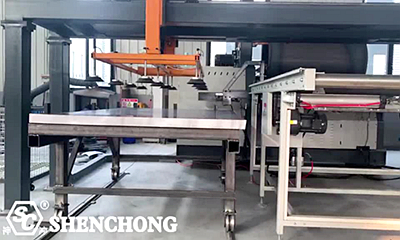
The metal rolling automatic loading and unloading system automates the original manual "handling-alignment-feeding-rolling-unloading" process through a robotic arm (gantry/robot), automatic centering mechanism, plate loading platform and finished product unloading device, greatly improving production efficiency and safety.
Automatic pick-up and positioning avoids slow manual alignment.
The truss can achieve an idle speed of 60–120 m/min.
Suitable for continuous rolling of large quantities of sheets of the same specifications.
Fixed feeding time, unaffected by human fatigue. Consistent alignment error each time, resulting in a more stable rolling cycle.
Overall continuous production efficiency improved by 30%–80%.
The system is linked with the rolling machine to pre-position the next sheet. Seamless feeding is possible after rolling is completed, reducing idle time.
Single sheets of 8–20mm thickness can weigh hundreds of kilograms or even tons. Automated loading/unloading replaces manual handling, eliminating the risks of human handling.
The rolling machine entrance area is a high-risk extrusion zone. Automated loading and unloading keeps personnel completely away from the roller area.
Laser scanning protects the winding area.
Collaborative software locks the rolling machine's operating status.
Automatic shutdown in case of abnormality + audible and visual alarm.
Laser or mechanical edge alignment device ensures alignment of both sides.
Error controllable within ±0.5~1 mm.
Significantly improved consistency of the first roll bending.
Traditional plate rolling machines typically require:
2 people lifting the plate
1 person centering the plate
1 person assisting with rolling
After metal rolling automation:
Only 1 person is needed for inspection and button operation
Especially for heavy-duty plate rolling operations with thicknesses of 20mm or more.
The automated system is available "on call," ensuring uninterrupted production.
Automatic feeding is more stable, preventing "roller collisions".
Reduces wear caused by uneven roller stress or collisions.
Extra-thick and extra-wide plates are difficult to handle safely manually.
Automation adapts to plates 8–60 mm thick without obstacles.
Can be linked with the following systems:
Laser/plasma cutting → Smart material storage → Plate rolling machine → Welding station
ERP/MES system automatic scheduling
Automatic recording of loading time, batch, and weight for each sheet.
Rolling cycle time can be tracked for capacity optimization.
Running time
Fault records
Loading quantity statistics
Standardized loading and unloading processes.
Reduce quality variations caused by differences in employee skill levels.
Automatic feeding speed is uniform and the angle is stable.
Greatly reduces defects such as "first roll taper" and "ovalness".
Feeding parameters for different specifications of plates can be saved.
One-click recall ensures stable accuracy in repeated production.
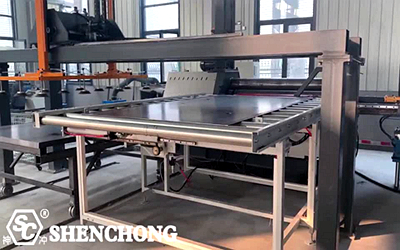
The features of automatic loading and unloading of plate rolling machines can be summarized from three dimensions: technical characteristics, process advantages, and application effects.
X/Y/Z three-axis servo or servo + roller combination.
High-speed, stable handling, adaptable to large-size sheet metal.
Supports complex path planning, capable of loading/unloading, flipping, stacking, etc.
Vacuum suction cup: suitable for light to medium-sized sheet metal (aluminum, stainless steel, thin steel plate).
Electro-permanent magnet suction cup: suitable for thick and heavy plates (8~25mm).
Mechanical jaws: suitable for irregularly shaped or extra-heavy sheet metal.
Laser ranging or mechanical edge alignment.
Ensures accurate sheet metal entry angle and position.
Stable accuracy of the first roll.
Networked with the plate rolling machine control system. Full-process linkage during rolling, automatic feeding/removal.
Safety interlock: Automatically locks loading/unloading actions during plate rolling machine operation.
Can handle sheet metal of different thicknesses, widths, and lengths. Expandable to multiple plate rolling machine production lines or integrated with intelligent material storage.
From the material table to the rolling machine and then to the unloading area, the entire process is handled by robotic arms. This avoids manual handling of large and thick plates, reducing operational risks.
Automatic sheet separation, centering, loading, and unloading are completed continuously. Stable rolling cycle time, suitable for mass production.
No need for personnel to approach high-risk rolling areas. The system has laser or infrared protection. Automatic shutdown alarm for abnormalities.
Automatic centering ensures accuracy on the first roll. Avoids problems such as sheet misalignment, taper, and ovality caused by manual material handling.
Loading time reduced by 50%–70%. Stable and predictable production cycle time.
From 3–4 people to automation, only 1 person is needed for inspection. Reduced labor intensity and safety risks.
Sheet batches, loading times, and rolling records are automatically recorded. Facilitates quality management and process optimization.
Can handle boards thicker than 20mm or wider than 2-6 meters. Automated processing of boards that are difficult and risky to handle manually.
The core value of metal rolling automatic loading and unloading system can be summarized in one sentence: Improved efficiency, reduced manpower, enhanced safety, ensured quality, and digitalization.
This system is particularly suitable for processing enterprises that:
* Have large quantities of heavy plates in large batches
* Have high requirements for rolling precision
* Have safety risks
* Have rising labor costs
The core features of the automated loading and unloading system for plate rolling machines are: high precision, speed, high safety, low manpower, traceability, and flexibility. It not only solves the problem of manually handling heavy plates, but also makes the plate rolling process more standardized, increases production capacity, and enhances safety.