+86-158-9507-5134
info@shenchong.com
 EN
EN

Automated steel storage system is three-dimensional, automated, and digital warehousing systems designed for steel plates, coils, profiles, pipes, and other metal raw materials. It's not simply replacing traditional shelving with electric equipment. Rather, it connects steel storage, automated handling, inventory management, order scheduling, production distribution, and laser cutting/shearing/bending equipment to form a complete intelligent logistics system.
From a current technological application perspective, automated steel warehousing has gradually evolved from simple "automatic storage and retrieval" to an integrated system of "warehousing + logistics + production line + information system." For example, intelligent steel plate warehousing solutions can already integrate automated storage and retrieval systems, inbound/outbound mechanisms, stacking mechanisms, AGVs, overhead cranes, cutting equipment, and warehouse management systems.
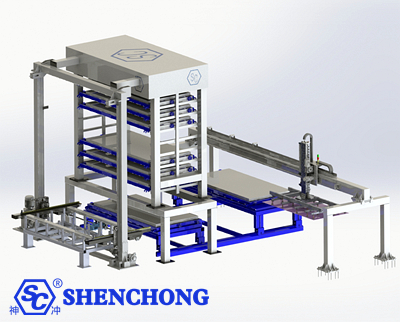
An automated steel storage warehouse is an intelligent, intensive, and automated warehousing system designed for metal raw materials such as steel plates, profiles, pipes, and coils. It achieves automated management of steel materials from warehousing, identification, storage, inventory, outbound delivery, and distribution to the production line through the collaborative use of equipment and software such as automated racking, automated conveying systems, stacker cranes, gantry robots, lifting mechanisms, AGVs/AMRs, warehouse management systems (WMS), and production management systems.
For traditional steel processing enterprises, automated steel storage warehouses are not merely "warehouses for storing steel," but crucial intelligent manufacturing nodes connecting procurement, warehousing, laser cutting, shearing, bending, welding, assembly, and finished products.
- Ground stacking
- Overhead crane transport
- Forklift handling
- Manual material retrieval
- Manual inventory recording
- Manual inbound/outbound scheduling
- Production department self-retrieving of materials
This model can meet the needs when the variety of steel types and inventory levels are small.
However, with the increasing variety of steel specifications, the increasing weight of plates, and the increasing fragmentation of production orders, traditional warehousing is prone to problems such as:
Large floor space required, difficulty in locating materials, low handling efficiency, high labor costs, inaccurate inventory, high safety risks, and long production waiting times.
Automated steel storage warehouses utilize racks, lifting mechanisms, stacker cranes, conveyor systems, robotic arms, AGVs, and WMS/WCS systems to achieve:
Automatic steel receiving → Automatic identification → Automatic allocation of storage locations → Automatic storage → Automatic inventory counting → Automatic material retrieval → Automatic distribution → Automatic entry into production equipment.
The core objective is not simply "to store steel," but to establish an identifiable, traceable, scheduleable, and automatically executed steel logistics center.
The true value of automated steel warehousing can be summarized in the following aspects:
Solving the problem of large floor space requirements for steel
Steel plates, coils, H-beams, I-beams, channel steel, aluminum profiles, and pipes are typically large in size.
Traditional warehousing often uses horizontal stacking:
Steel plate → Ground → Steel plate → Ground → Steel plate
This not only requires a large area but also necessitates ample space for forklifts or overhead cranes to facilitate lifting.
Automated storage systems, on the other hand, fully utilize the vertical space of the factory building.
For example:
1st floor
2nd floor
3rd floor
4th floor
5th floor
…
10th floor
With the factory floor area remaining constant, increasing the number of storage layers increases the storage capacity per unit area.
Some automated warehousing systems can even utilize the factory height to store tens or even hundreds of tons of steel within a relatively small floor area.
A complete automated steel storage system typically consists of the following components:
This is the foundation of the entire warehouse.
It primarily supports steel plates, coils, profiles, or pallets.
Dependency options include:
- Drawer-type racking
- Pallet-type racking
- Heavy-duty racking
- Cantilever racking
- Automatic racking
- Multi-level racking
- Shuttle racking
- Specialized steel plate storage racking
For heavy-duty steel plate storage, the racking system must prioritize:
Single-layer load-bearing capacity, overall load-bearing capacity, deflection, stability, impact resistance, and long-term fatigue performance.
The lifting mechanism is responsible for transferring steel between different heights.
For example:
Ground → 8th layer
Or:
8th layer → Outbound platform
Common types include:
- Chain lifting
- Wire rope lifting
- Hydraulic lifting
- Motor-driven lifting
- Servo lifting
For high-precision automated warehousing, lifting positioning accuracy is particularly important.
This is the core execution component for warehouse automation.
It can employ:
- Stacker cranes
- Robots
- Extended forks
- Electric trolleys
- AGVs
- RGVs
- Gantry robots
- Gantry handling mechanisms
Different materials require different handling methods.
For example:
Typically, forks, robots, magnetic suction devices, or dedicated picking mechanisms are used.
More suitable is: Gantry robots + grippers For handling.
Currently, there are automated gantry profile storage systems specifically designed for long materials such as H-beams, I-beams, channel steel, angle steel, and pipes.
This is a crucial point when selecting equipment.
It's incorrect to assume that all steel uses the same type of automated storage.
In fact, it should be categorized according to material form.
Main Storage Items:
- Carbon steel plate
- Stainless steel plate
- Galvanized plate
- Aluminum plate
- Copper plate
- Thick steel plate
- Laser-cut sheet metal
Typical Application:
Steel plate warehouse → Laser cutting machine → Automated feeding → Cutting → Finished product unloading
This is one of the most common forms of automated storage in the sheet metal processing industry.
Modern sheet metal AS/RS systems can directly connect sheet metal inventory to production equipment such as laser cutting machines and punching machines.
Typical structure of automated steel plate warehouses:
The system often adopts a multi-column, multi-tower, or multi-station structure.
For example, a multi-tower automated storage system can be configured with multiple storage columns and access different storage locations via stacker cranes, while simultaneously setting up multiple inbound/outbound workstations to transport raw materials to equipment such as laser cutting machines and punching machines.
Steel coils are completely different from steel plates.
Steel coils have the following characteristics:
- Large weight
- Large outer diameter
- Circular structure
- Special center of gravity
- Risk of rolling
- High handling requirements
Therefore, specialized steel coil storage equipment is required.
A typical structure includes:
Steel coil storage space + heavy-duty support frame + Automated Guided Vehicle (AGV) + overhead crane/stacking equipment + weighing system + Work Management System (WMS).
This system can achieve the following:
Steel coil warehousing → Weighing → Barcode/RFID scanning → Automatic storage location allocation → Automatic storage → Receiving production tasks → Automatic coil retrieval → Uncoiling line
For steel coil processing companies, this model is particularly suitable for:
- Steel coil slitting
- Slitting line
- Laser cutting
- Stamping production
- Sheet metal processing
- Steel distribution center
Profiles include:
- H-beams
- I-beams
- Channel steel
- Angle steel
- Square tubes
- Round tubes
- Rectangular tubes
- Aluminum profiles
- Steel rails
- Long steel strips
The main characteristics of these materials are:
Long length, heavy weight, and irregular shape.
Therefore, the following is more suitable:
Gantry-type automated warehousing
Gantry robots can move in multiple directions (X/Y/Z) to achieve:
- Automatic material retrieval
- Automatic material unloading
- Automatic positioning
- Automatic sorting
- Automatic outbound processing
This type of system is especially suitable for steel structure manufacturing companies.
Traditional warehouses have a large area occupied by:
- Aisles
- Forklift aisles
- Overhead crane operating areas
- Manual operation areas
Automated storage and retrieval systems (AS/RS) can improve space utilization through vertical storage.
Steel plates, especially thick plates, are very heavy.
For example:
10mm steel plate × 1500 × 3000mm
Weight approximately:
353kg/sheet
For even thicker plates, the weight of a single sheet can reach hundreds of kilograms or even several tons.
Manual handling is obviously impractical.
Automated equipment can handle a large number of repetitive handling tasks.
Traditional steel warehouses suffer from:
- Forklift collisions
- Steel plate tipping
- Overhead crane risks
- Personnel accidental entry
- Falling heavy objects
- Human-machine cross-operation
Automated warehousing addresses these issues through:
- Safety light curtains
- Laser scanning
- Guardrails
- Access control
- Area detection
- Interlocks
- Overload detection
- Fall prevention
- Fault alarms
Reducing the probability of personnel directly entering heavy-load handling areas.
Actual steel AS/RS case studies also show that automation can reduce human involvement in heavy-load handling and improve the working environment.
Traditional steel inventory often results in:
System displays 100 tons, but actual inventory is only 93 tons.
Reasons include:
- Missing entries
- Missing exit entries
- Incorrect specification records
- Incorrect material records
- Material location not updated after material movement
- Remaining materials not re-registered
Automated warehouses can integrate with:
- Barcodes
- QR codes
- RFID
- Weighing
- Location sensors
- Automatic inventory counting
Establishing digital material files.
Traditional steel stacking easily leads to:
- Surface scratches
- Edge collisions
- Sheet deformation
- Rust
- Mixed materials storage
Automated warehousing can allocate fixed storage locations according to material type, specifications, and material composition.
Especially for:
Materials with high surface quality requirements, such as stainless steel, aluminum sheets, galvanized sheets, and color-coated sheets
The value is very significant.
A key value of automated sheet metal storage systems is reducing deformation and damage caused by manual handling.
This is a value of automated warehousing that is often overlooked.
Consider a laser cutting machine:
It operates very quickly.
However, if the operator takes:
20 minutes to find the material.
The laser machine is essentially waiting the entire time.
An automated warehouse can complete the following processes in advance:
Material preparation → Scheduling → Outbound → Conveying → Loading
Ultimately achieving:
The warehouse supplies materials to the production equipment.
Therefore, the truly advanced solution is not:
automation of the automated warehouse alone
but rather:
automated warehouse + laser cutting machine + press brake bending machine + welding robot + MES
forming a complete production chain.
Steel arrives
↓
Scan/identify barcode
↓
Confirm size/weight
↓
WMS generates inventory information
↓
System automatically assigns storage location
↓
Material handling mechanism picks up material
↓
Automatically enters storage location
↓
Inventory update
Production order
↓
MES generates material requirements
↓
WMS checks inventory
↓
WCS generates task
↓
Automatically finds storage location
↓
Material handling mechanism picks up material
↓
Outbound conveyor
↓
Laser cutting/shearing/production line
↓
Automatic inventory deduction
Hardware is only one part of an automated warehouse.
What truly determines the "intelligence" of the system is the software.
Typically includes:
Primarily responsible for:
Inbound, Outbound, Inventory, Storage Location, Batch Management, Inventory Counting, Inventory Alerts
Responsible for coordinating:
Stacker Cranes, Conveyors, Elevators, Gantry Robots, AGVs, Automatic Doors, Other Actuators
Simply put: WMS manages "what," WCS manages "how to move."
If further connected to the production system, it can achieve:
Order → Scheduling → Materials → Processing → Production → Quality → Finished Product
Full-process digitalization.
This is a highly worthwhile model to implement in the sheet metal industry.
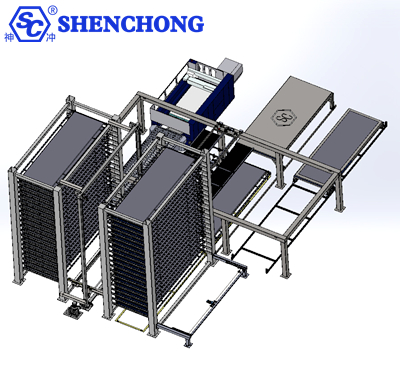
For example:
Automated steel plate warehouse
↓
Automated plate retrieval system
↓
Automated plate conveying
↓
Fiber laser cutting machine
↓
Automated unloading/sorting
↓
Finished product logistics
This enables: Automatic raw material supply.
Furthermore, it can achieve:
Raw material storage → Laser cutting → Semi-finished product storage → Automated bending → Welding → Finished product storage
Creating a truly intelligent sheet metal factory.
For shearing production lines, the following can be designed:
Automatic steel plate storage + Automatic feeding + Shearing machine
For example:
Steel plate warehouse
↓
Automatic outbound
↓
Plate positioning
↓
Automatic feeding
↓
Hydraulic guillotine shearing machine
↓
Fixed-length shearing
↓
Finished product stacking
This reduces manual lifting and forklift transportation.
For mass production of sheet metal, the value of automation is particularly evident.
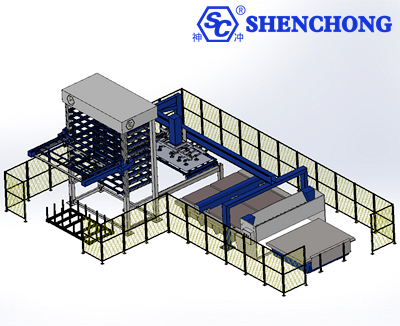
Further integration can achieve:
Laser cutting → Automated sorting → Automated buffering → Robotic bending
The automated warehousing system is responsible for: material flow.
The Manufacturing Execution System (MES) is responsible for: production task flow.
Robots are responsible for: processing execution.
Ultimately forming a flexible manufacturing cell.
When purchasing, don't just ask, "How much does your warehouse cost?" Focus on the following parameters.
Parameters | Importance |
Maximum Sheet Size | ★★★★★ |
Maximum Single Layer Load Capacity | ★★★★★ |
Total Inventory Weight | ★★★★★ |
Number of Storage Locations | ★★★★★ |
Number of Storage Layers | ★★★★ |
Maximum Warehouse Height | ★★★★ |
Single Retrieval Weight | ★★★★★ |
Inbound/Outbound Speed | ★★★★★ |
Positioning Accuracy | ★★★★ |
Automation Level | ★★★★★ |
WMS Functionality | ★★★★★ |
ERP/MES Interface | ★★★★★ |
Security System | ★★★★★ |
Equipment Stability | ★★★★★ |
Maintenance Expectations | ★★★★ |
Expandability | ★★★★ |
It cannot be determined simply by "how many tons of steel."
At least the following needs to be considered:
For example:
- Q235
- Q355
- 304
- 316L
- Aluminum sheet
- Galvanized sheet
For example:
- 1mm
- 2mm
- 3mm
- 6mm
- 10mm
- 16mm
- 20mm
- 30mm
For example:
1500×3000
2000×4000
2000×6000
2500×6000
3000×12000
For example:
Average inventory 100 tons
Peak inventory 180 tons
Therefore, the warehouse design should consider peak inventory plus safety stock, not just average inventory.
A reasonable warehousing system should consider:
Average inventory + Peak inventory + Safety stock + Future growth potential
For example:
Current inventory: 100 tons
Future projected: 150-200 tons
If designed directly for 100 tons, expansion will likely be necessary in two to three years.
Therefore, it is recommended to reserve approximately 20%-30% expansion capacity during the design phase.
The specific percentage needs to be calculated based on the company's growth rate, factory height, and investment budget.
This is the most common problem.
Even if the warehouse is automated, but:
Warehouse → Laser Cutting Machine
Manual forklift handling is still required.
Then the overall automation level of the system remains limited.
Low-priced racking is not necessarily suitable for heavy-duty steel.
The following must be considered:
Structural safety + load-bearing capacity + drive system + control system + software + safety system.
For:
- Stainless steel
- Aluminum plate
- Galvanized plate
- Color-coated plate
Special consideration should be given to the material of the contact surfaces and the handling methods.
A large amount of leftover material is generated after laser cutting.
An excellent automated warehouse not only manages "whole steel plates"
but also considers "leftover sheet material".
For example: 304 / 3mm / 1200×850mm
The system automatically records this.
If the next production run requires:
1000×800mm
The system can prioritize using surplus material.
This can significantly improve material utilization.
Characteristics:
- Various steel plate specifications
- Many laser equipment
- Large inventory
- High order volume
- High labor costs
Very suitable.
Especially suitable for:
- H-beams
- I-beams
- Channel steel
- Angle steel
- Square tubes
- Equal length profiles
For example:
- Excavators
- Loaders
- Crane
- Agricultural machinery
Requires large quantities of steel plates.
Characteristics:
- Large-size steel plates
- Thick plates
- Heavy weight
- High inventory
Especially suitable for:
Steel procurement → warehousing → sorting → length cutting → processing → distribution
This business model.
If a company:
- Has very little steel inventory
- Has a very limited range of steel specifications
- Has very few daily outbound shipments
- Has ample factory space
- Has low labor costs
- Lacks a digital production system
Then building a fully automated warehouse may not yield a high return on investment.
In this case, it's advisable to first adopt:
semi-automatic racking + electric handling equipment + barcode/WMS
instead of building a fully automated AS/RS system from the outset.
Don't just calculate:
saving a few workers.
You should calculate the overall benefits of the system.
Direct benefits:
- Reduced labor
- Reduced forklift use
- Reduced overhead crane use
- Reduced warehouse space
- Reduced material loss
- Reduced inventory errors
Indirect benefits:
- Increased laser machine utilization
- Shortened production preparation time
- Shortened order delivery time
- Increased inventory turnover
- Increased material utilization
- Reduced safety accident risk
Therefore, the true ROI should be:
labor savings + space savings + reduced material loss + increased equipment utilization + increased order fulfillment capacity - investment and maintenance costs of the automated system
Future steel warehouses will not simply be "automatic racks."
They will evolve in the following directions:
Utilizing factory height for three-dimensional storage.
Suitable for:
Thick steel plates, heavy steel, and large-format profiles.
Utilizing algorithms for:
Warehouse location optimization, automatic scheduling, inventory forecasting, and production scheduling.
Gradually shifting from:
Manual material sourcing to: System material sourcing.
Ultimately becoming: System proactively preparing materials based on production plans.
A typical future factory might be:
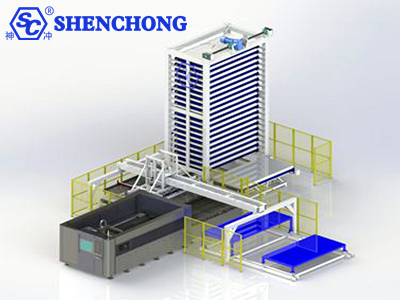
Intelligent steel warehouse + laser cutting + automatic bending + robotic welding + AGV logistics + MES
Forming a complete intelligent manufacturing system.
If your company is preparing to purchase, it is recommended to follow the order below.
Statistics:
Material, specifications, thickness, length, width, weight, and inventory.
Clarify:
Daily inbound volume? Daily outbound volume? Peak season volume?
Options:
Level 1: Manual Warehousing
↓
Level 2: Semi-automatic Warehousing
↓
Level 3: Automated Storage and Retrieval
↓
Level 4: Automated Warehousing + WMS
↓
Level 5: Automated Warehousing + WMS + MES + ERP + Production Equipment
Don't blindly pursue the highest level; determine the level based on the actual production process.
From a business perspective, automated steel storage system can be summarized in 6 points:
Direction | Traditional Warehouses | Automated steel warehouse |
Storage | Flat Stacking | High-bay storage |
Transportation | Manual/Forklift/Overhead Crane | Automatic material handling |
Warehouse Location | Manual Management | Automatic system management |
Inventory | Manual Statistics | Real-time digital inventory |
Production Supply | Manual Delivery | Automatic delivery |
Data | Isolated | ERP/MES/WMS interconnection |
Ultimately, this will achieve:
Higher space utilization, higher handling efficiency, more accurate inventory, lower personnel risk, shorter production waiting time, and provide a stable automated logistics foundation for intelligent sheet metal factories.
The value of automated steel warehousing will be even more pronounced for companies with steel plate inventories of tens or hundreds of tons, coupled with multiple laser cutting machines, shearing machines, bending machines, and robotic production lines.
From a business perspective, the value of automated steel warehouses can be summarized as:
"Storing more, finding faster, handling more stably, managing more accurately, using less, and connecting more effectively."
It not only solves the problem of "where to put" steel, but more importantly, it solves the problem of: "How to efficiently get steel into the production line."
For modern sheet metal companies, the truly efficient model is not about purchasing a single laser cutting machine, shearing machine, or bending machine, but about gradually establishing a complete intelligent manufacturing system:
Intelligent warehousing → Automated loading and unloading → Laser cutting → Automated sorting → Automated bending → Robotic welding → Finished product logistics.
Therefore, automated steel storage systems can be seen as one of the logistics infrastructures for intelligent sheet metal factories and digital steel processing factories. Especially for enterprises with large steel inventory, many material specifications, frequent order changes, and a high degree of equipment automation, their value is not only reflected in saving warehouse space and labor costs, but also in improving material turnover rate, equipment utilization rate, production continuity, and the overall digital management level of the factory.