+86-158-9507-5134
info@shenchong.com
 EN
EN
A Practical Selection Guide Cone Roll Bending Machines are mainly used to roll metal sheets into cylinders, arcs, conical bodies, smaller heads, frustums, and other workpieces. They are widely used in industries such as pressure vessels, boilers, fans, environmental protection equipment, chemical equipment, storage tanks, steel structures, pipelines, and machinery manufacturing.
Many users tend to only look at the "maximum thickness × maximum width" and the equipment price when purchasing. However, whether a cone rolling machine can truly meet production requirements depends on multiple factors, including plate thickness, plate width, material, minimum rolling diameter, taper, forming accuracy, rolling method, roller structure, hydraulic system, control system, and workpiece type.
The following is a systematic analysis from aspects such as processing requirements, equipment structure, parameter selection, rolling capacity, accuracy, materials, rollers and common misconceptions.
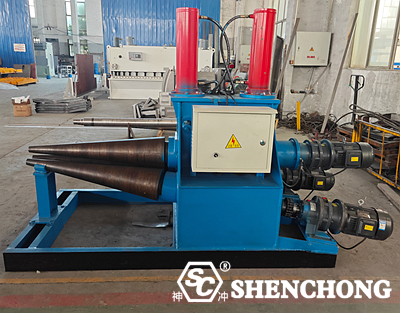
A conical rolling machine is a type of forming equipment specifically used to roll metal sheets into conical or cylindrical workpieces.
- Cylinders
- Arcs
- Rings
- Cylinders
- Turrets
- Tubes
- Cones
- Fractional cones
- Cone tubes
- Cone hoppers
- Cone funnels
- Cone tanks
- Cone ducts
- Cone shells
- Cone pressure vessel components
The term "conical rolling" essentially refers to creating a curvature with different inner and outer diameters on the sheet metal during the rolling process. The rolling diameters on the left and right sides of the sheet metal are different.
For example:
- Large end diameter: 2000 mm
- Small end diameter: 1000 mm
- Sheet thickness: 10 mm
- Sheet width: 2500 mm
In this case, the workpiece is not an ordinary cylinder, but a truncated cone. Its forming radii at both ends are completely different.
Therefore, the cone roll bending machine not only needs to bend the sheet metal, but also needs to make the sheet metal bend and relative displacement to different degrees during the rolling process.
This is the most crucial step in the procurement process.
Many users, when inquiring about prices, only tell the manufacturer, "I need a 20×2500 tapered plate rolling machine." In reality, this information is far from sufficient.
Because: 20×2500 does not directly mean that the machine can roll the tapered shape you need.
At least the following parameters should be clarified:
Item | Required Specifications |
Material | Q235, Q355, stainless steel, aluminum plate, etc. |
Maximum Thickness | Examples: 10 mm, 16 mm, 20 mm |
Maximum Width | 2000, 2500, 3000, 4000 mm, etc. |
Maximum Diameter | Example: 2000 mm |
Minimum Diameter | Example: 500 mm |
Cone Angle | Example: 5°, 10°, 20°, 30° |
Large End Diameter | Example: 2000 mm |
Small End Diameter | Example: 1000 mm |
Sheet Length | Axial length |
Rolling Method | Cold coil/Hot coil |
Output | Single piece, small batch, continuous production |
Precision | Standard structural parts/High precision |
Automation Level | Manual/Hydraulic/NC/CNC |
Pre-bending Required | Yes/No |
Workpiece Requirements | One-time forming required? |
The "maximum coil thickness" of a taper rolling machine is the easiest parameter to understand during procurement, but also the easiest to misunderstand.
This usually means the machine's design capacity is approximately:
Maximum coil thickness 16 mm, maximum effective coil width 2500 mm.
However, it is important to note:
"16 mm" does not mean that 16 mm can be rolled in all situations.
Actual capacity is closely related to the following factors:
- Material tensile strength
- Yield strength
- Plate width
- Roller diameter
- Cone angle
- Small end diameter
- Plate condition
- Pre-bending required
- Equipment structure
- Roller diameter
- Number of rolling passes
The actual rolling capacity of Q235 and high-strength steel plates may differ significantly.
Therefore, when purchasing, it's best not to simply ask, "Can this machine roll 16mm?"
Instead, you should ask:
"For Q235 steel plates, 16mm thick and 2500mm wide, what are the required diameters at the large and small ends, and what is the cone angle? Can it be rolled continuously and stably?"
This is the effective technical confirmation.
Coiling width generally corresponds to the effective working length of the equipment.
1500 mm
2000 mm
2500 mm
3000 mm
3200 mm
4000 mm
5000 mm
6000 mm (Longer Specifications)
This can generally be understood as:
A rated plate thickness of approximately 16 mm
An effective coiling width of approximately 2500 mm
However, for tapered cone machining, width affects not only ordinary cylinders but also:
The axial length of the cone.
Therefore, special attention needs to be paid to:
Maximum coiling width ≠ The maximum axial length of all your tapered products.
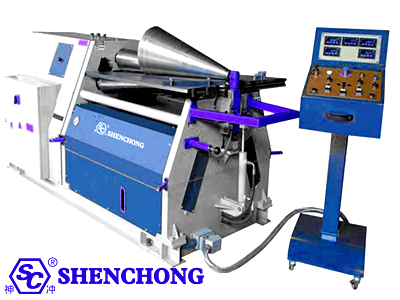
This is a very important indicator in selecting a tapered cone machine.
For example, your product:
Small end: φ300mm
Large end: φ1200mm
Then the equipment must not only be able to roll 20mm plates, but also stably complete the φ300mm small end forming under specified material and cone angle conditions.
Many equipment advertises impressive parameters, but the minimum diameter may be the real limitation to actual production.
For example: Small end φ500mm, large end φ1800mm.
Or: Small end φ800mm, large end φ2500mm.
The large end diameter determines the product size range and also affects the equipment's working stroke and workpiece handling method.
If the user mainly processes cones, the cone angle is often more important than the ability to roll ordinary plates.
For example:
3°
5°
10°
15°
20°
30°
45°
60°
Different equipment has different adaptability.
In particular:
Large cone angle + thick plate + small end diameter
This is a relatively difficult processing combination.
Therefore, when purchasing, you must tell the manufacturer:
Large end diameter: 2000 mm
Small end diameter: 1000 mm
Axial length: 2500 mm
Then calculate the actual cone angle and the unfolded dimensions of the plate.
For example:
1000mm, 2000mm, 2500mm, 3000mm, 4000mm.
The larger the length, the higher the requirements for the equipment:
- Rigidity
- Roller deflection
- Hydraulic synchronization
- Plate support
At least specify:
- Q235
- Q355
- 304
- 316L
- Aluminum alloy
- Wear-resistant steel
- High-strength steel
Material strength directly affects the actual rolling capacity of the equipment.
Workpiece drawings must be provided when requesting a quote.
This is the most professional purchasing method.
Ideally, the following should be provided:
- Finished product image
- Plate thickness
- Material
- Large end diameter
- Small end diameter
- Cone angle
- Length
- Weld requirements
- Precision requirements
This information is crucial for manufacturers to select the right equipment.
To summarize this in one sentence:
Selecting a cone roll bending machine is not simply about choosing a model based on "plate thickness × plate width," but rather a comprehensive selection based on "material + thickness + width + large end diameter + small end diameter + cone angle + minimum diameter."
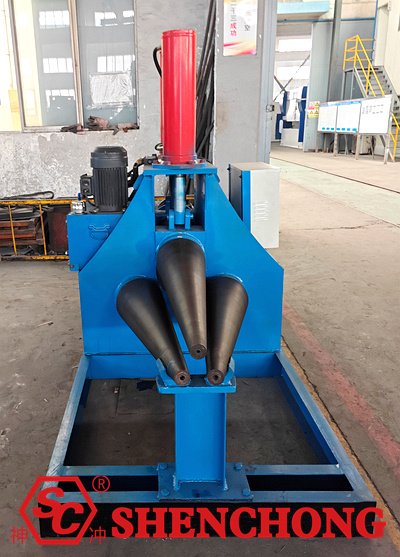
Especially important are the following 12 core indicators:
- Maximum plate thickness
- Maximum plate width
- Material grade
- Minimum rolling diameter
- Maximum rolling diameter
- Large end diameter
- Small end diameter
- Maximum taper angle
- Roller diameter and rigidity
- Control system
- Actual test roll results
To condense the entire purchasing process into the simplest principles, remember:
① Check the product: What kind of cones are being produced?
② Check the material: Q235, Q355, stainless steel, or high-strength steel?
③ Check the dimensions: maximum thickness, width, small end diameter, large end diameter.
④ Check the cone angle: small or large cone angle?
⑤ Check the equipment: rollers, frame, hydraulics, drive, control, pre-bending, unloading.
⑥ Check the test paper: use your own materials and your own product drawings to create an actual test paper.