+86-158-9507-5134
[email protected]
 EN
EN
Hydraulic metal sheet shear machine is mainly used for straight-line cutting of metal sheets to set dimensions. Below is a detailed user and maintenance guide for guillotine hydraulic shearing machines, convenient for training, equipment management, or writing operation manuals.
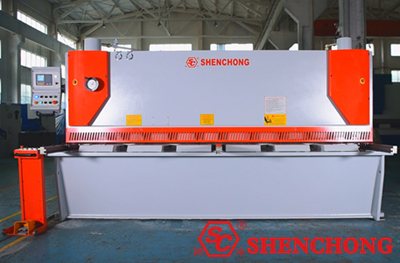
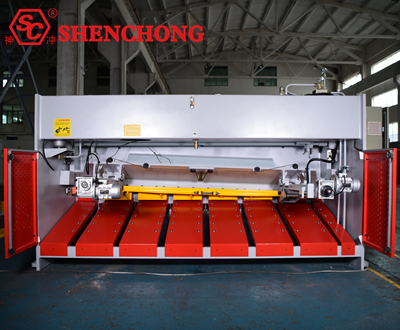
The guillotine hydraulic shearing machine uses a linear reciprocating motion of the upper blade holder, driven by a hydraulic system, to shear sheet metal.
Its features are:
- High shearing force, suitable for medium and heavy plates
- High shearing accuracy (especially straightness)
- Strong structural rigidity and good stability
- Suitable for carbon steel, stainless steel, aluminum plates, etc.
Shearing machines are high-risk equipment. Before formal operation, the following principles must be established:
Operators must understand:
- Equipment structure
- Start-stop procedure
- Emergency stop location
- Back gauge adjustment method
- Blade gap adjustment method
- Common troubleshooting methods
This is the most important safety rule.
Whether test-cutting, blade alignment, material cleaning, or handling, hands must not be placed between the upper and lower blades, under the pressure device, or within the dangerous travel range.
The equipment has limits on its rated shearing thickness, shearing length, and material strength. Overloading will result in:
- Blade chipping
- Blade holder deformation
- Hydraulic system overload
- Motor burnout
- Inaccurate shearing dimensions
Any adjustments, maintenance, or cleaning must be performed after the machine is stopped, power is disconnected, and pressure is released.
Recommendations:
- Non-slip safety shoes
- Well-fitting work clothes
- Cut-resistant gloves for handling sheet metal
- Safety goggles to protect against flying metal shavings
- Long hair must be tied back; Do not wear jewelry that could get caught in equipment.
Items must be checked one by one:
- Is the oil level above the center line of the oil gauge?
- Is the oil clean (no emulsification, no impurities)?
- Is the oil temperature between 15℃ and 60℃?
- Is the upper and lower blades securely fastened?
- Is there any chipping or wear on the blade edge?
- Is the pressing device returning to its normal position?
- Is the emergency stop button reset?
- Is the control system (e.g., E21S) starting normally?
- Is the limit switch effective?
- Is the protective cover closed?
- Is the photoelectric protection (if any) functioning properly?
- Is there any obstruction in the back gauge area?
- Turn on the main power supply
- Start the oil pump motor
- Run the machine idle for 2-3 minutes (preheat the hydraulic system)
- Check if the pressure gauge is stable
- Perform an empty shear test (no load)
Set the CNC system (e.g., E21S) according to the shearing dimensions. For high precision requirements, "fine-tuning + trial shearing" is recommended.
Shearing gap ≈ 5%–10% of plate thickness
Plate thickness | Gap |
1mm | 0.05–0.1mm |
5mm | 0.25–0.5mm |
10mm | 0.5–1.0mm |
- Too small a clearance → Rapid blade wear
- Too large a clearance → Excessive burrs
- Small angle: High precision, small deformation
- Large angle: Small shearing force, labor-saving
- Too small → Plate slippage
- Too large → Severe indentation
- The plate must be tightly against the back gauge.
- Large plates require auxiliary support (to prevent sagging).
- Irregular plates require manual positioning.
- Step on the foot switch or press the button.
- The pressure cylinder presses the plate.
- The upper blade holder moves downward to shear.
- Automatic return stroke.
- The back gauge moves (CNC mode).
- Shearing excessively thick materials is strictly prohibited.
- Shearing two different materials on top of each other is prohibited.
- Shearing quenched steel or high-hardness materials is prohibited.
- Hands must not be placed in the blade area.
- Stop the machine immediately if any abnormality occurs.
Use the maximum clearance (approximately 10%) to prevent sticking and keep the blade sharp.
Slightly smaller clearance. Take care to prevent scratches.
Standard clearance is sufficient. Widest applicability.
This is the most practical part. It is recommended that the operating team follow this procedure daily.
Is the oil level normal? Are there any oil leaks? Are the blades loose? Is the back gauge accurate? Are the emergency stop and foot pedals functioning properly? Are the guards and safety devices intact?
During operation, pay attention to:
- Are there any abnormal noises?
- Is the oil pump making a high-pitched scream?
- Is the material pressing action smooth?
- Is the blade return smooth?
- Is the motor overheating abnormally?
- Are there any system alarms?
- Clean up metal shavings from the workbench.
- Wipe off oil stains from the plate surface.
- Remove debris from the back gauge guide rail.
- Clean up scraps from the floor.
- Check for impurities adhering to the blade edge.
It is recommended to establish an equipment operation record sheet, recording:
- Material cut that day
- Cut thickness
- Cut quantity
- Abnormal situations
- Maintenance and handling details
Long-term records can help determine if the equipment is aging or being overloaded.
The hydraulic system is the core of the shearing machine. Proper maintenance of the hydraulic system will significantly extend the equipment's lifespan.
After prolonged use, hydraulic oil will:
- Oxidize
- Contaminate
- Contain Water
- Change Viscosity
Oil deterioration will affect:
- Pressure stability
- Action speed
- Pump life
- Seal life
The replacement cycle should be determined based on the intensity of use, environment, and oil quality. If the equipment operates under high load for extended periods, the inspection cycle should be more frequent.
Contamination is a major enemy of the hydraulic system.
Dust, metal particles, and moisture will damage:
- Pump
- Valve assembly
- Cylinder
- Seal rings
Always use clean filtering tools when adding oil; never add oil with the nozzle open.
Overheating of the oil can lead to:
- Decreased oil viscosity
- Increased internal leakage
- Weak operation
- Aging seals
If the equipment frequently experiences high temperatures, check:
- Cooling system
- Ambient ventilation
- Excessive load
- Clogged oil lines
If you experience:
- Excessive noise
- Insufficient pressure
- Slow operation
- Weak return stroke
- Significant vibration
Focus on checking for air intake on the oil pump suction side, filter blockage, overflow valve malfunction, and directional valve sticking.
Aging of cylinder seals, joint seals, and valve block seals can cause leaks.
Leaks are not minor issues; they can contaminate the floor or cause unstable pressure and abnormal operation.
Blades are one of the most direct consumables of shearing machines.
- Significantly increased burrs
- Uneven cut
- Duller shearing sound
- Requires greater pressure to cut
- Exhibits deformation at the edge of the sheet
Many shearing machine blades are multi-sided.
When one side is worn, it can be flipped or rotated according to the machine's structure.
However, the following must be noted:
- Stop the machine and disconnect the power
- Release the pressure
- Disassemble and reassemble in sequence
- Ensure the bolt torque is even
- Readjust the blade gap after reassembly
After adjustment, mass production cannot proceed immediately. A test cut must be performed and the cut quality observed.
If the following is found:
- Large burrs at the top
- Large burrs at the bottom
- Slanted cut
- Obvious secondary tearing
The gap needs further fine-tuning.
If there are metal shavings, oil stains, or burrs on the back of the blade and the contact surface with the blade holder, it will cause:
- Uneven blade installation
- Offset of the shearing line
- Abnormal localized stress
- Premature blade damage
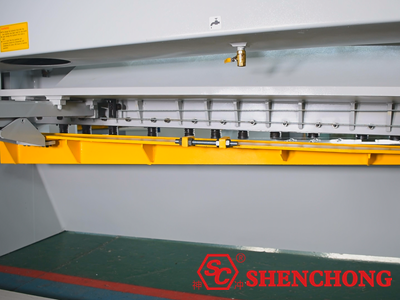
The hydraulic metal sheet shear machine back gauge directly determines the cutting dimensional accuracy.
- Debris, dust, and grease will hinder the smooth movement of the backgauge.
- It should be cleaned regularly and lubricated appropriately.
If the left and right backgauges are not synchronized, it will lead to:
- Wavy edges
- Dimensional deviation
- Difficulty in plate positioning
Including:
- Lead screw
- Lead nut
- Synchronous belt
- Bearings
- Couplings
If the clearance is too large, the backgauge accuracy will decrease significantly.
It is recommended to use a steel ruler, calipers, or standard measuring tools to verify the backgauge position to avoid "display correct, actual deviation".
The function of the pressure plate is to fix the plate and prevent it from warping or shifting during cutting.
- Insufficient clamping
- Unsynchronized clamping
- Failure to return to center after clamping
- Worn clamping foot
- Internal leakage in hydraulic cylinder
- Keep the clamping surface clean.
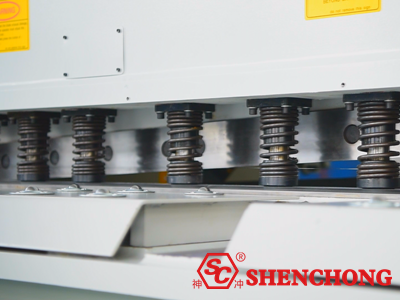
- Check the condition of the clamping spring or hydraulic cylinder.
- Check the clamping hydraulic circuit and valves.
- Check the wear of the clamping pad.
Electrical faults can cause equipment to fail to start or malfunction.
Prevent dust, oil, and moisture from entering the electrical cabinet.
After prolonged vibration, wiring terminals may become loose, causing:
- Poor contact
- Signal loss
- Control abnormalities
- False alarms
The emergency stop button must be sensitive and reliable. The foot switch must not be stuck, leaking current, or malfunctioning.
For example, back gauge limit switches, tool holder travel switches, and pressure detection switches.
Sensor failure will cause the equipment to be unable to accurately control its movements.
Below is a practical maintenance schedule for easy daily management.
- Check oil level
- Check for leaks
- Clean worktable and guide rails
- Test emergency stop and foot pedal
- Observe blade condition
- Check bolt tightness
- Check blade clearance
- Check back gauge accuracy
- Clean around hydraulic station
- Check electrical cabinet heat dissipation
- Check hydraulic oil contamination
- Check filter element
- Check material pressing device
- Check electrical terminals
- Check lubrication of all moving parts
- Calibrate back gauge
- Comprehensive blade wear check
- Check oil pump and valve assembly operating status
- Check cylinder seal leaks
- Consider replacing hydraulic oil and filter element based on usage
- Check overall machine accuracy
- Perform systematic overhaul of major components
- Check motor insulation and electrical control system aging
- Excessive clearance
- Blade wear
- Adjust clearance
- Replace or grind blades
- Insufficient clamping pressure
- Inappropriate shearing angle
- Increase clamping pressure
- Adjust shearing angle
- Uneven blade clearance
- Loose fasteners
- Readjust blade edge
- Tighten bolts
- Oil contamination
- Prolonged high load
- Replace hydraulic oil
- Add cooling system
- Weared lead screw
- Encoder error
- Calibrate system
- Replace parts
Many people can operate the equipment, but not everyone can "cut well."
The quality of a guillotine hydraulic shearing machine mainly depends on the following points:
- Rapid blade wear
- Easy to chip
- Increased load
- Large burrs
- Cracked cross-section
- Uneven sheared edges
Generally, the blade gap should be adjusted according to the material and thickness. Thin plates and high-strength materials cannot use the same value.
In principle: The harder and thicker the material, the larger the gap should generally be.
Insufficient material pressure will cause the sheet to warp during shearing, resulting in:
- Beveled edges
- Burrs
- Wavy edges
- Dimensional deviations
Warping, bending, or localized bulging of the sheet material will all affect shearing accuracy.
Try to keep the sheet material flat against the worktable.
Frequent continuous shearing in pursuit of efficiency can easily lead to:
- Increased oil temperature
- Increased hydraulic system impact
- Reduced blade life
Especially for thick or high-strength plates, the cycle time should not be too fast.
A dull blade not only increases burrs but also causes "compression shearing," leading to plate deformation.
The condition of the blades is more important than many people realize.
Correct Clearance = 50%+ Increase in Blade Life
Regular Oil Changes = Double the Lifespan of Hydraulic Systems
Avoid Overloading = Prevent Structural Deformation
Rotate Blades = Reduce Costs
Maintain Cleanliness = 30%+ Reduction in Failure Rate