+86-158-9507-5134
[email protected]
 EN
EN
The fully automated nickel plate shearing line is an integrated automated equipment system designed for the processing of nickel and nickel-based alloy plates. It integrates processes such as feeding, leveling, conveying, positioning, shearing, stacking, waste disposal, and data control onto a single production line, achieving continuous, unmanned, or minimally manned processing from coils or plates to finished sheets.
Due to the high strength, high toughness, high surface requirements, and susceptibility to scratches and deformation during processing, traditional manual shearing or semi-automatic equipment often suffers from low efficiency, unstable dimensional accuracy, significant surface damage, and high labor intensity.
The emergence of fully automated nickel plate shearing production lines is precisely to meet the demands for high-precision, high-consistency, high-cleanliness, and high-efficiency nickel plate processing, and it is widely used in new energy, electroplating, chemical, aerospace, electronics, special materials, energy storage, battery casings, and high-end metal products.
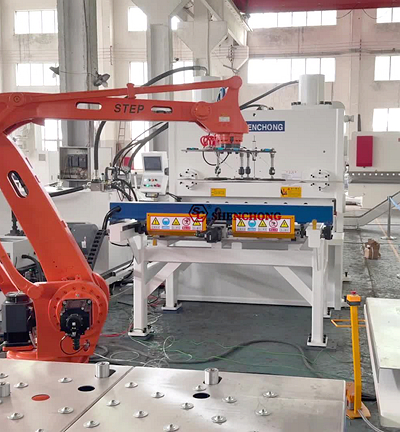
A complete fully automated nickel plate shearing line typically consists of the following core units:
This system automatically transports the nickel plate raw materials to the starting position of the production line.
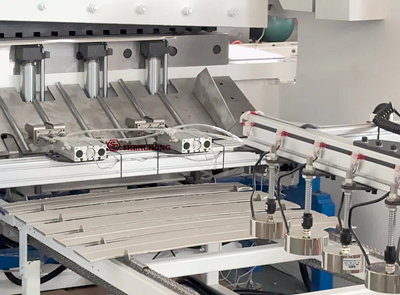
Common forms include:
- Robotic arm feeding
- Vacuum suction cup feeding
- Magnetic chuck loading and unloading system
- Gantry crane feeding
- Roller conveyor feeding
- Coil uncoiling feeding system
This system reduces manual handling, prevents the plates from bumping, scratching, and deforming, and improves feeding speed and continuous operation capability.
Nickel plates are prone to bending, warping, and uneven internal stress during transportation and storage. The leveling system uses a multi-roller flattening structure to repeatedly level the plates, ensuring their flatness meets shearing requirements.
Leveling quality directly affects subsequent shearing accuracy and finished product flatness; therefore, this is one of the key links in the entire production line.
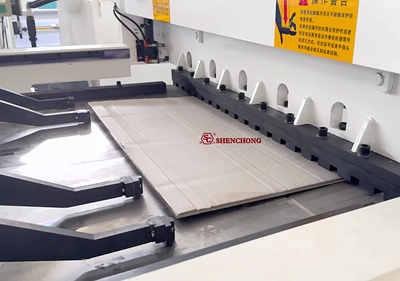
This system accurately transports the nickel plates to the shearing position according to the set length, width, and shearing cycle time.
Typically, the following methods are used:
- Servo motor drive
- High-precision ball screw or synchronous belt drive
- Encoder closed-loop control
- Photoelectric detection and limit positioning
Its advantages include stable feeding, accurate positioning, low repeatability error, and the ability to meet high-standard dimensional requirements.
The shearing main unit is the core execution unit of the production line, mainly responsible for shearing nickel plates to fixed length, fixed width, or in segments.
- Front-feeding guillotine shearing machine
- Mechanical shearing machine
- Hydraulic shearing machine
- Flying shear continuous shearing structure
For thicker nickel plates or high-strength nickel alloy plates, hydraulic or heavy-duty guillotine shearing solutions are usually more suitable to ensure stable shearing force, good cut quality, and longer tool life.
After shearing, the nickel plates automatically enter the conveyor section and are neatly stacked by the stacking mechanism.
This step significantly reduces manual handling time, avoids scattered, scratched, or misaligned plates, and improves subsequent packaging and warehousing efficiency.
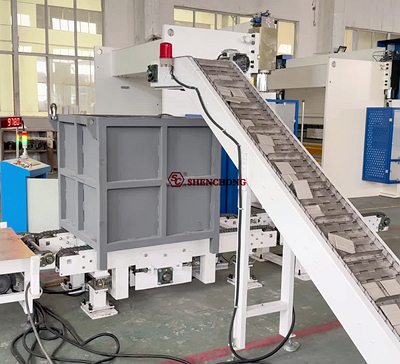
The entire production line typically consists of a PLC, touchscreen, servo control, sensor system, and safety interlock system.
The control system can achieve:
- Length, quantity, and batch setting
- Automatic continuous operation
- Fault alarm
- Parameter memory
- Production statistics
- Remote maintenance interface
- Integration with MES/ERP systems
This makes the production process more intelligent, transparent, and traceable.
The typical workflow of a fully automated nickel plate shearing production line is as follows:
- Raw material enters the loading station.
- The nickel plate is automatically fed into the leveling section.
- After leveling, it enters the servo feeding system.
- The system feeds precisely according to set parameters.
- The shearing host performs fixed-length shearing.
- The finished product is transported to the stacking table.
- Automatic sorting, counting, and stacking.
- Waste and corner pieces are collected and processed uniformly.
The entire process requires almost no manual intervention, enabling stable, continuous, and high-speed processing.
Nickel plate is a high-value material and is very sensitive to dimensional errors. The fully automated production line adopts servo feeding, closed-loop control, and a high-rigidity shearing structure, which can significantly improve shearing accuracy, making each plate more uniform in size and reducing rework and scrap.
Compared to ordinary carbon steel or aluminum plates, nickel plates often have higher strength and more special processing requirements.
Fully automated shearing lines are optimized in terms of blade material, shearing angle, pressure system, and frame structure, making them more suitable for processing high-hardness and high-toughness materials.
Nickel plates are typically used in high-end industrial applications with stringent surface quality requirements.
Automated conveying and precise clamping reduce bumps, friction, and contamination caused by manual handling, significantly improving finished product surface quality and reducing material scrap rates.
Compared to manual shearing on a single machine, automated shearing machine lines can achieve uninterrupted operation, suitable for batch and standardized production.
Especially when orders are concentrated and delivery deadlines are tight, it can significantly increase production capacity.
Modern nickel plate shearing lines are typically equipped with human-machine interfaces and program control systems. Operators only need to input specifications, and the equipment can automatically complete feeding, shearing, counting, and stacking.
This "parametric production" method greatly reduces reliance on skilled workers.
The following can be added according to customer needs:
- Automated sorting system
- Online inspection system
- Laser length measurement system
- Visual recognition system
- MES data acquisition system
- Automated packaging system
Therefore, the entire production line is not only suitable for current production, but also easy to upgrade and modify in the future.
Manual shearing of nickel plates often suffers from slow feeding, slow positioning, and repetitive labor.
Automated production lines enable continuous feeding and shearing, significantly increasing production cycle time, making them particularly suitable for large-volume orders and standard-sized plate processing.
Traditional processing methods require multiple workers for handling, alignment, shearing, and stacking, resulting in high labor costs and high labor intensity.
Fully automated production lines reduce the number of on-site operators, achieving minimal or even unmanned operation.
Manual operation is susceptible to the influence of experience, fatigue, and physical condition, leading to problems such as dimensional fluctuations, uneven cuts, and plate surface damage.
Automated equipment, through program control and mechanical repeatability, ensures high consistency in each batch of products.
Nickel is a high-value material, and any waste directly impacts costs.
Automated shearing lines offer superior positioning accuracy, shearing stability, and stacking neatness, effectively reducing waste from edge material, miscutting, and rework.
Nickel plates are heavy and have sharp edges, posing risks of pinching, scratching, and impact injuries during manual handling and shearing.
Automated systems delegate dangerous tasks to equipment, significantly improving workshop safety.
In the fields of new energy, batteries, chemicals, and high-end equipment manufacturing, customers demand not only high output but also quality, stability, and traceability.
Automated shearing production lines better meet these high-standard application scenarios.
The equipment records shearing quantity, specifications, operating status, and alarm information, providing data support for production statistics, quality tracking, process optimization, and equipment maintenance. This is crucial for modern digital factories.
The fully automated nickel plate shearing line is suitable for:
- Pure nickel plates
- Nickel alloy plates
- Nickel-based corrosion-resistant alloy plates
- Nickel-plated composite plates
- High-strength nickel material plates
- Some special metal thin or medium-thick plates
Typical application areas include:
- New energy battery industry
- Chemical equipment industry
- Electroplating and surface treatment industry
- Aerospace industry
- Electronics and precision manufacturing industry
- Special metal products industry
- Energy storage and power battery related industries
- High-end metal parts processing plants
Nickel plates have high hardness, resulting in significant tool wear. Therefore, tools are typically made of high-strength alloy steel or special heat-treated materials.
Simultaneously, the shearing gap must be precisely adjusted according to the material thickness and material composition to ensure a smooth cut, minimal burrs, and long tool life.
Due to the large shearing force, the production line frame must possess high rigidity and vibration resistance; otherwise, shearing accuracy and equipment lifespan will be easily affected. Heavy-duty welded frames, overall annealing, and precision machining are key to improving stability.
Feeding accuracy determines the shearing dimension accuracy.
Servo systems, code feedback, sensor detection, and control algorithms collectively determine the equipment's stability level.
To address the easily scratched surface of nickel plates, the equipment's contact parts typically employ:
- Anti-scratch rubber rollers
- Wear-resistant guide plates
- Soft contact pads
- Smooth transition conveyor structure
To minimize surface damage.
The production line should be equipped with:
- Emergency stop button
- Safety light curtain
- Access control interlock
- Overload protection
- Material shortage alarm
- Fault shutdown protection
To ensure long-term stable operation of the equipment.
Advantages: Low initial investment, suitable for small-batch temporary processing.
Disadvantages: Low efficiency, unstable accuracy, high reliance on manual labor, high labor intensity, and high probability of plate surface damage.
Semi-automatic shearing offers some improvement over manual shearing, but still requires considerable human intervention and has limited automation, making it suitable for small to medium-scale production.
Fully automated shearing production lines offer the most significant advantages:
· Continuous production
· High precision
· High efficiency
· Traceability
· Less human intervention
· Strong stability
· Suitable for large-scale processing
For high-value, high-requirement materials like nickel plates, fully automated solutions offer greater long-term economic viability.
While the initial investment in a fully automated nickel plate shearing production line is higher than that of ordinary single-machine equipment, the long-term comprehensive benefits are very significant:
- Increased production efficiency leads to increased output value
- Reduced labor leads to lower costs
- Reduced material waste leads to increased profits
- Improved product consistency leads to increased customer satisfaction
- Increased automation enhances enterprise competitiveness
For enterprises seeking stable orders, large-scale processing, and quality control, this is a highly valuable upgrade direction.
The fully automated nickel plate shearing line is a highly efficient automated processing equipment specifically designed for the characteristics of nickel and nickel-based alloy materials. It integrates automatic feeding, leveling, conveying, shearing, stacking, and control, enabling high-precision, high-efficiency, and high-stability continuous processing.
Its core value lies not only in "replacing manual labor," but more importantly, in achieving dimensional consistency, surface protection, production acceleration, cost optimization, and management upgrades in the processing of high-value nickel materials. For enterprises looking to increase capacity, reduce waste, and enhance quality competitiveness, this type of equipment has very strong application value and investment significance.