+86-158-9507-5134
info@shenchong.com
 EN
EN
The robotic automated bending unit is an automated processing equipment that deeply integrates a CNC bending machine, a high-precision industrial robot, an automatic gripping system, and an intelligent control system. Through a unified control platform, the system coordinates the bending process with robot movements, automatically completing the entire process of sheet metal gripping, positioning, flipping, multi-bending, and unloading. It is suitable for high-precision, high-efficiency automated production of medium to large batches of sheet metal parts.
Core Values:
- Automated continuous production, significantly increasing capacity
- Stable bending accuracy, high batch consistency
- Reduced reliance on manual labor, reducing labor costs
- Significantly improved production safety
- Easy integration with smart factories and digital management systems
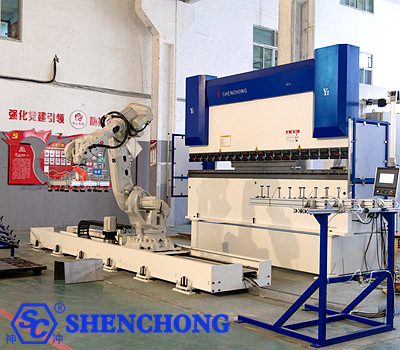
- Hybrid/Electro-hydraulic servo CNC bending machine
- Multi-axis back gauge system (X, R, Z, etc.)
- CNC control system (supports automatic program calling)
- Deflection compensation system
- Bending angle compensation function
- 6-axis high-precision industrial robot (ABB/KUKA/FANUC, etc.)
- High repeatability positioning accuracy
- Multi-angle flipping and attitude control
- Dedicated robot control cabinet
- Vacuum suction cup gripper/mechanical gripper
- Multi-zone vacuum control
- Adjustable gripper structure
- Adaptable to workpieces of different sizes and thicknesses
- Loading platform/unloading platform
- Automatic positioning device
- Flip-plate positioning device
- Finished product palletizing system
- Automatic material storage interface
- Safety fence
- Photoelectric protection device
- Safety interlock door
- Emergency stop and system interlock control
- The loading platform places the sheet material to be processed.
- The robot automatically picks up the sheet material and feeds it into the bending machine.
- The bending machine completes the first bend according to the program.
- The robot automatically flips, rotates, and repositions.
- Multiple consecutive bends are completed.
- The robot delivers the finished product to the unloading area or stacking area.
- The system automatically enters the next cycle.
- The entire process requires no manual intervention, achieving continuous automatic production.
The robotic automaed bending unit is not simply a combination of a "bending machine + robot," but rather achieves truly systematic automatic bending through unified control logic and process collaboration:
* The bending machine (hydraulic/hybrid/fully electric servo) and the robot achieve signal interlocking.
* The bending program and robot trajectory are synchronously invoked.
* Bending sequence, flipping action, and positioning reference are uniformly planned.
* Supports one-click start of the entire bending cycle.
Value Proposition:
Avoids cycle instability and misoperation caused by manual intervention, achieving true "unmanned bending."
Automated bending systems typically utilize 6-axis or 7-axis industrial robots combined with specialized grippers to achieve complex bending actions:
* Multi-degree-of-freedom for sheet metal flipping, rotation, edge changing, and repositioning
* Gripper supports vacuum suction cups/mechanical grippers/hybrid structures
* Rapid switching for different sheet thicknesses, sizes, and weights
* Supports irregularly shaped parts, asymmetrical parts, and multi-edge workpieces
Value proposition:
Overcomes the limitations of manual bending in terms of size, weight, and complex structures, significantly improving process adaptability.
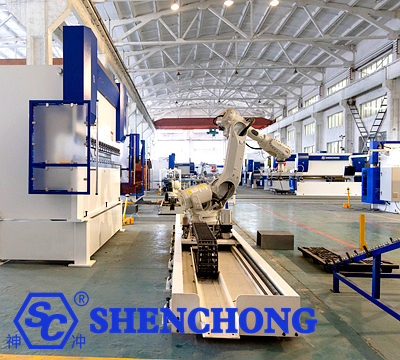
One of the core values of robotic automatic bending lies in “eliminating human variables”:
* Robot repeatability can reach ±0.02 mm (depending on the model)
* Sheet material is always fed into the bending area according to the set benchmark
* Unaffected by operator experience, fatigue, or emotions
* Extremely high consistency in angle, size, and appearance
Typical Effects:
* Significantly reduced angle deviation in batch products
* Reduced rework and scrap
* Particularly suitable for the production of standard parts and serialized products
Advanced robotic automatic bending units often integrate multiple intelligent compensation functions:
* Automatic compensation for bending angle (material springback correction)
* Automatic correction of bending depth based on changes in sheet thickness and strength
* Linked follow-up between the back gauge and robot movements
* Optional angle detection system for closed-loop control
Value Manifestation:
Maintains stable bending quality even with different batches of materials, significantly reducing the difficulty of machine setup.
The robotic automatic bending unit enables true continuous production:
* Automatic feeding → Bending → Flipping → Multiple bending → Automatic unloading
* One person can simultaneously monitor multiple sets of equipment
* 24-hour continuous operation, suitable for night shifts or unmanned shifts
* Stable and predictable bending cycle time
Comparison with manual bending:
* Manual efficiency is greatly affected by skill level
* Automatic bending has a stable cycle time and higher long-term efficiency
* Slightly slower single-piece cycle time, but stronger overall capacity
The robotic automatic bending unit can be connected to other automation systems:
* Integrate with laser cutting machines, shearing machines, and automatic material storage systems
* Integrate with automatic palletizing, turnover tables, and AGV systems
* Build a complete sheet metal automated production line
Value proposition:
Reduces manual handling and transfer time, significantly improving overall production efficiency.
Bending operations inherently carry high safety risks.
The robotic automated bending system enhances safety through:
* Human-machine isolation (safety fences/light curtains/safety doors)
* No entry into hazardous areas
* Multi-level safety interlocks
* Automatic shutdown alarm for abnormal situations
Value:
Reduces workplace injury risks, meeting the high safety standards of modern factories.
In the sheet metal industry, skilled bending workers face long training cycles and high turnover. The robotic automated bending system:
* Reduces reliance on highly skilled workers
* Operators primarily handle material loading monitoring and program calls
* Significantly shortens new employee training cycles
* Stabilizes long-term production capacity
- Programmed and Data-Driven Bending Management
The robotic automated bending system possesses significant digital advantages:
* Programmed storage of bending process parameters
* Product switching only requires program calls
* Supports production data statistics and traceability
* Can be integrated with MES/ERP systems
Value:
Lays the foundation for factories to move towards intelligent manufacturing and digital workshops.
In summary, robotic automatic bending systems are particularly suitable for:
* Mid-to-large batch production of sheet metal parts
* Products with high repeatability and relatively stable specifications
* High requirements for quality consistency
* Regions with high labor costs and labor shortages
Robotic Automated Bending = High Consistency + High Safety + High Automation + Long-Term Stable Production Capacity
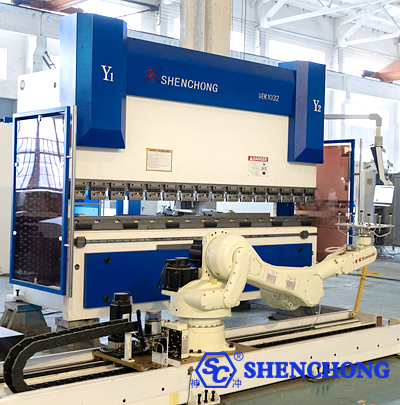
The robotic automated bending unit, through deep integration of bending equipment and industrial robots, upgrades the production mode from manual bending to automated and digital bending. This system significantly improves production efficiency and safety while ensuring high precision and stable quality, making it a crucial core equipment in modern intelligent sheet metal manufacturing production lines.
The robot-automated bending system deeply integrates CNC bending machines with high-precision industrial robots, achieving synchronized actions, program linkage, and rhythmic coordination through a unified control system. The system can automatically complete the entire process of sheet metal gripping, positioning, flipping, multi-process bending, and unloading, enabling one-click continuous production and significantly reducing manual intervention, ushering in a stable and replicable unmanned era for bending production.
Industrial robots possess extremely high repeatability positioning accuracy. Combined with an intelligent back gauge system, bending compensation technology, and angle control system, it ensures that the bending angle, dimensions, and appearance of each product are highly consistent. Whether in continuous production or batch order processing, consistent quality can be maintained, significantly reducing errors, rework, and material waste caused by manual operation.
The system adopts a multi-degree-of-freedom robot and modular gripper design, which can flexibly handle the bending needs of sheet metal parts of different sizes, thicknesses, and complex structures, enabling rapid changeover production. It also supports integration with automatic material storage, laser cutting, shearing, and automatic palletizing systems to build a complete automated sheet metal production line, improving production efficiency while reducing labor costs and safety risks, comprehensively enhancing the enterprise's intelligent manufacturing level.