+86-158-9507-5134
info@shenchong.com
 EN
EN
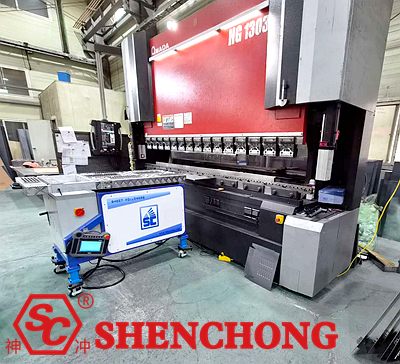
The sheet bending follower system ordered by our Korean distributor 모아커팅 More Cutting, for their client has been installed and commissioned. The Korean client has already put it into operation.
Shenchong sheet bending follower system can not only be used with our press brake machines, but also work in conjunction with other brands of machines, such as Amada from Japan. Our Korean distributor provides local installation and commissioning services for the bending follower system in Korea.
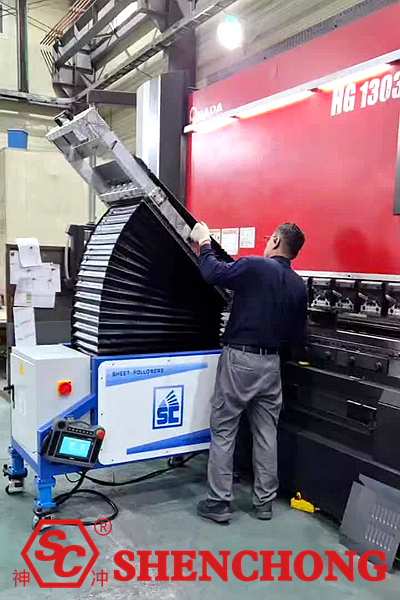
A bending follower device is an auxiliary support device installed in front of a CNC press brake machine. During the bending process, the follower arm rises, falls, or rotates synchronously with the slider movement and the bending angle of the sheet metal, providing dynamic support for the sheet metal and reducing sagging, deformation, and the physical burden on operators.
For large sheet metal parts, long plate bending, thick plate bending, and the processing of stainless steel and aluminum plates, the sheet bending system can effectively improve processing stability, operational safety, and production efficiency.
When bending long plates, large-sized panels, or heavy sheet metal, the portion of the sheet metal extending beyond the die is prone to sagging due to its own weight. The follower device provides support along with the bending action, reducing the risk of deformation caused by sheet metal sagging, and is especially suitable for long workpieces and large-area thin plates.
Operators no longer need to continuously lift large sheet metal by hand, reducing the burden of prolonged bending, lifting, and adjusting workpieces, reducing fatigue, and improving operational comfort during continuous production.
The follow-up support reduces swaying and sudden drops of the sheet metal during bending, allowing it to follow the upper die more smoothly and helping to maintain workpiece posture and consistency in the bending process.
More stable sheet metal support helps reduce processing fluctuations caused by workpiece weight, operator lifting differences, and changes in sheet metal position. However, actual angular accuracy still depends on factors such as material properties, die, back gauge positioning, machine tool compensation, and the control system.
Reducing the need for manual lifting of heavy sheet metal lowers the risks of workpiece slippage, imbalance, collisions, and muscle strain. The follow-up device is an auxiliary safety device and cannot replace the bending machine's optical grating, laser protection, and clamping point protection measures.
Reducing the time spent on manual material handling, temporary adjustments, and repetitive positioning, especially in long plates, multi-pass bending, and repetitive batch processing, helps shorten auxiliary operation time.
A well-designed material support surface and rolling or low-friction contact structure help reduce sheet metal dragging, scratching, and localized indentations. This is especially valuable for materials with high surface finish requirements, such as mirror stainless steel, brushed steel, and aluminum.
For large-format thin plates, long-side bending, wide-format cabinet panels, and electrical cabinet housings, the servo support helps control the sheet metal's posture, reducing operational difficulties caused by sheet metal deflection.
Depending on the workpiece size and equipment configuration, single-sided or double-sided servo supports can be selected, and combined with CNC synchronous control, back gauges, and other auxiliary equipment, improving the operability of bending large workpieces and multi-process bending.
The servo device can coordinate with the CNC bending machine, reducing reliance on skilled material handling personnel and creating conditions for standardized operation, process repetition, and subsequent automation upgrades.
The following situations typically warrant a high level of configuration value:
- Long sheet metal length: A significant portion of the workpiece extends beyond the mold, making it prone to sagging due to its own weight.
- Large sheet metal area: Wide panels are difficult for a single person to support stably.
- Thin sheet metal bending: The sheet metal has low rigidity, making it more prone to swaying or bending during bending.
- Heavy workpiece weight: Continuous manual support places a significant burden on the worker.
- Surface protection required: Brushed stainless steel, mirror-finished stainless steel, coated stainless steel, or aluminum sheets.
- Mass production: Aims to reduce auxiliary time spent on repeated material handling, adjustment, and positioning.
- Reduced reliance on manual labor: A desire to standardize operating procedures and prepare for automated production.
For small, lightweight, and simple-to-handle workpieces, a standard front support may be sufficient. Whether to configure a follow-up device should be determined based on workpiece size, material thickness, weight, bending method, and production cycle time.
The core value of bending follower devices can be summarized in four points:
- More stable support: Reduces sagging and swaying of large sheet metal.
- Easier operation: Reduces the burden of manual lifting and material handling.
- More controllable processing: Helps improve workpiece posture consistency and surface protection levels.
- More efficient production: Reduces auxiliary operations, creating conditions for standardized and automated production.
For the production of large electrical cabinets, HVAC equipment, long stainless steel sheets, and wide sheet metal panels, Korea sheet bending follower systems are often an auxiliary configuration worthy of in-depth evaluation.