+86-158-9507-5134
[email protected]
 EN

SHENCHONG W12 four-roller plate bending machine 12X1300MM is a hydraulic, CNC-controlled piece of equipment designed for rolling, cylinder forming, and arc-bending of thin to medium-thickness metal plates. The W12 series utilizes a four-roller configuration, which offers several advantages: stable plate clamping, superior pre-bending performance, high rolling precision, ease of operation, and a high degree of automation.
The machine is primarily designed for handling plates with a maximum thickness of approximately 12mm and an effective working width of about 1300mm (actual capacity may vary based on material strength, cylinder diameter, and specific equipment configuration). It is well-suited for applications in sectors such as small-to-medium-scale sheet metal processing, pressure vessel component manufacturing, ventilation equipment production, general machinery manufacturing, and the fabrication of metal cylinders.
It should first be noted that the designation "12×1300" refers to the machine's nominal bending capacity; it does not imply that a 12 mm plate thickness can be achieved for all types of materials or across all bending diameters.
The following is a framework of reference parameters for a machine of this specification. The final, definitive specifications should be based on the official technical agreement provided by the manufacturer.
Parameter Item | Reference Specifications |
Equipment Model | W12 12×1300 |
Equipment Type | |
Maximum Plate Thickness | 12 mm (reference) |
Maximum Plate Width | 1300 mm |
Number of Rollers | 4 rollers |
Upper Roller | Main drive roller |
Lower Roller | Clamping roller |
Side Roller | One on each side (left and right) |
Drive Method | Hydraulic drive |
Control Method | CNC/PLC control (optional or based on specific configuration) |
Processing Type | Cylindrical, arc, and conical shapes (requires appropriate configuration) |
Main Functions | Pre-bending, rolling, and calibration (rounding) |
Safety Protection | Hydraulic protection, mechanical limit stops, emergency stop, etc. |
Note:
The table above provides reference specifications for product introduction purposes; it does not represent verified, manufacturer-specific factory parameters. For actual procurement, please confirm the following details: minimum rolling diameter, material capacity at full load, pre-bending thickness, roll diameter, main motor power, and operating speed.
The core advantage of the W12 four-roller plate bending machine lies in the coordinated operation of its four rolls. Unlike traditional three-roll machines, the four-roll design uses the bottom roll to clamp the plate, while the side rolls (left and right) are adjusted to perform pre-bending and circular rolling.
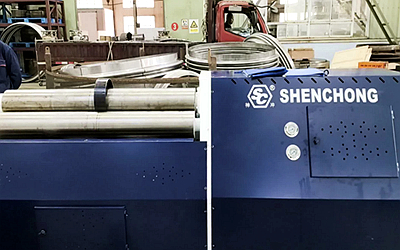
The top roll is one of the primary working rolls, responsible for providing the main rotational force required during the plate-rolling process.
Key functions:
Driving the continuous forward movement of the plate.
Working in conjunction with the side rolls to bend the plate.
Ensuring the stable movement of the plate during the rolling process.
Providing support for forming cylinders of various diameters.
The bottom roll primarily serves to clamp the plate.
Key features:
- Moves vertically via a hydraulic system.
- Securely clamps the plate between the top and bottom rolls.
- Prevents the plate from slipping during the rolling process.
- Assists the side rolls in achieving precise positioning.
The adequacy of the clamping force exerted by the bottom roll directly impacts rolling precision and processing stability.
The side rolls are critical components for executing pre-bending and circular rolling in a four-roll plate bending machine.
Hydraulic cylinders control the vertical movement of these rolls, allowing for adjustments to the degree of curvature applied to the plate.
Key functions:
- Performing pre-bending on both ends of the plate.
- Adjusting the rolling radius of the cylinder.
- Controlling the degree of plate curvature.
- Working with the top and bottom rolls to facilitate continuous circular rolling.
The hydraulic system provides the power required for the movement of the top, bottom, and side rolls.
Key components include:
- Hydraulic pump station
- Hydraulic cylinders
- Solenoid directional control valves
- Hydraulic piping
- Pressure control valves
- Hydraulic filtration and cooling units (depending on the configuration)
The stability of the hydraulic system directly affects the equipment's positioning accuracy, clamping capacity, and operational efficiency.
The CNC system is responsible for controlling the position of the rollers, their direction of rotation, and the rolling operations.
The use of a PLC or CNC system enables the following functions:
- Side roller position control
- Bottom roller clamping control
- Roller rotation (forward/reverse) control
- Storage of rolling programs
- Multi-pass processing control
- Monitoring of the operational process
Control system configurations vary significantly between manufacturers. Therefore, one cannot determine whether a machine features automatic rolling programs based solely on its "W12" model designation.
The working principle of a W12 four-roller plate bending machine involves clamping a metal plate between the upper and lower rollers, then adjusting the positions of the side rollers to induce continuous plastic deformation in the plate, ultimately forming the desired cylindrical or arc-shaped structure.
The entire process is divided into four main stages.
The metal plate to be processed is placed between the lower roller and the side rollers.
The position of the lower roller is adjusted to guide the plate into the clamping zone between the upper and lower rollers.
Key considerations during this stage include:
Ensuring the plate surface is clean.
Ensuring the plate edges are as flat and even as possible.
Aligning the centerline of the plate with the centerline of the equipment.
Setting an appropriate clamping pressure based on the material thickness.
The lower roller moves upward, clamping the plate against the upper roller.
The position of one of the side rollers is then adjusted to induce plastic bending at one end of the plate.
This process helps eliminate the "flat ends" (straight sections) that would otherwise remain at the ends of the cylinder.
Once the ends of the plate have been pre-bent, the upper and lower rollers drive the plate to rotate.
The side rollers (on both the left and right) are adjusted to achieve the target bending radius, gradually shaping the plate into an arc.
By repeatedly adjusting the positions of the side rollers, the desired cylinder diameter is progressively achieved.
Once the rolling process is complete, the machine is brought to a stop.
Depending on the specific design of the equipment, the workpiece is removed—typically by opening a drop-end bearing, releasing the end of the upper roller, or utilizing another unloading mechanism.
Finally, the cylinder is inspected for roundness, diameter, and the gap at the seam.
If any slight ovality or localized deformation is detected, the cylinder can undergo further calibration (rounding) to correct its shape.
Eliminates the need to repeatedly flip the plate; both ends can be pre-bent and the main body rolled in a single clamping setup, reducing auxiliary processing steps.
The upper and lower rolls clamp the plate securely, minimizing the risk of slippage or misalignment during the rolling process.
Roll positions and processing programs can be configured via the control system, simplifying manual operation.
Precise adjustment of the side rolls improves the roundness and diameter consistency of the finished cylinders.
The hydraulic system powers the clamping and roll adjustment mechanisms, accommodating plates of varying thicknesses.
Equipped with a conical rolling attachment or specialized control functions, the machine can produce conical shells and components with varying diameters.
The four-roll clamping and continuous rolling process minimize the need for flipping or repositioning the plate.
Features such as a hydraulic drop-end or a tilting upper roll mechanism allow for the easy removal of finished cylindrical workpieces.
Constructed from high-quality alloy forged steel and subjected to advanced heat treatment and surface finishing, the rolls offer excellent resistance to wear and deformation.
Capable of processing cylinders of various diameters, curved plates, and certain conical components, making it well-suited for a wide range of production requirements.
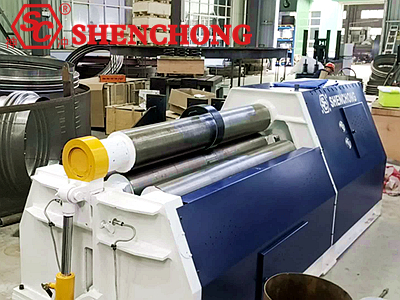
This type of equipment is primarily designed for rolling thin to medium-thickness plates.
Typical applications include:
- Stainless Steel Storage Tanks: Liquid storage tanks, food-grade containers, and cylindrical sections for chemical vessels.
- Ventilation Ductwork: Circular air ducts, exhaust pipes, and ventilation cylinders.
- Pressure Vessel Components: Cylindrical vessel sections and other circular components, manufactured in compliance with relevant industry standards.
- Machinery Manufacturing: Equipment housings, protective guards, and metal cylinders.
- Architectural Decoration: Curved metal decorative panels and arched structural elements.
- Environmental protection equipment industry: dust removal equipment, filtration equipment, and environmental protection vessels (cylindrical containers).
To ensure the quality of the rolled cylinders, several key factors must be controlled during actual production:
Different materials have varying yield strengths, which dictate the required rolling pressure.
For example:
- Q235 ordinary carbon steel: Can serve as a baseline reference for standard equipment selection.
- Q355 high-strength steel: Requires accounting for higher rolling loads.
- 304 stainless steel: Requires consideration of material strength, work hardening, and surface protection.
It cannot be assumed that because a machine can roll 12mm carbon steel, it is automatically capable of rolling 12mm stainless steel.
Insufficient pre-bending at the ends of the plate often results in "flat spots" (straight edges) at the cylinder's seam.
Methods for improvement:
- Properly set the initial positions of the side rolls.
- Control pre-bending pressure and displacement.
- Employ a multi-stage pre-bending process.
- Make adjustments based on the material's springback characteristics.
The rolling radius is primarily influenced by the position of the side rolls, the diameter of the rolls, the thickness of the plate, and the material's properties.
During the processing, the side roll positions can be incrementally adjusted through trial rolling and measurement.
Before rolling, the plate must be correctly aligned to ensure it remains parallel to the roll axes, with uniform clamping force applied across its width.
Once the rolling process is complete, the unloading procedure must be carried out strictly according to the equipment's operating instructions. Never attempt to manually remove a workpiece while the rolls are still rotating or before the workpiece is securely supported.
The W12 four-roller plate bending machine 12x1300mm is a hydraulic system designed for processing small-to-medium-sized metal plates. Its primary value lies in integrating plate clamping, edge pre-bending, and continuous rolling into a single unit, thereby reducing the need for repetitive positioning and manual intervention common in traditional rolling processes.
The value of this equipment is reflected in three key areas:
- Processing Efficiency: Minimizes the need for turning the plate, repositioning, and performing separate auxiliary pre-bending operations.
- Processing Quality: Ensures consistent cylindrical forming through the clamping action of the top and bottom rolls, combined with adjustments from the side rolls.
- Production Flexibility: Capable of processing a wide range of cylindrical components, curved plates, and select conical workpieces.
Precise Pre-bending · Efficient Rolling · Stable Forming
Plate pre-bending and rolling are completed in a single setup. Through the coordinated control of four rolls, the system balances processing precision, production efficiency, and ease of operation—offering an efficient and reliable solution for the forming of thin to medium-gauge metal plates.