+86-158-9507-5134
[email protected]
 EN

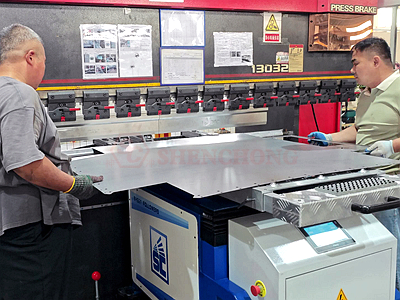
The customer purchased the Shenchong sheet follower for hemming process. Bending and pressing the dead edge is a very important forming process in sheet metal processing. It is mainly used to bend the edge of the metal plate to a certain angle first, and then through secondary bending and pressing, the edge of the plate finally forms a fitting structure close to 180°. The bending follower device can effectively assist workers in processing the dead edges of large plates. Save time and effort and improve safety.
Edge pressing, also known as flattening, folding, or sheet metal edge wrapping, is widely used in industries such as electrical cabinets, chassis, automotive parts, door panels, elevator decorative panels, kitchenware, and stainless steel products. This process not only improves the edge appearance of sheet metal products but also increases edge rigidity, reduces the risk of scratches from sharp burrs, and enhances the overall structural strength of parts.
Edge pressing utilizes a CNC press brake bending machine with a specialized edge pressing die to process the edge of sheet metal from an initial flat state into a closed structure of approximately 180°.
It typically consists of two main processing stages:
- Pre-bending stage: The edge of the sheet metal is first bent to approximately 30°–45°, forming an open fold.
- Filling stage: The pre-bent portion is placed in a specialized flattening die, and pressure is applied through a slider to gradually close and flatten the fold.
The final edge pressing structure typically consists of the sheet metal edge folded inwards by 180°, with the two layers of sheet metal tightly bonded together.
During the pressing and finishing process on a bending machine, configuring a sheet follower support system effectively assists in the positioning, support, and flipping of large sheet metal parts, reducing the impact of the sheet metal's weight on the processing.
Especially when processing long, large-area, and heavy sheet metal workpieces, the follower can move with the bending machine's slide, synchronously adjusting the support angle and position, helping operators to complete pre-bending and pressing operations more stably.
Edge pressing typically involves two stages: pre-bending and secondary pressing. During the pre-bending stage, the edge of the sheet material gradually bends upwards or downwards, and the main body of the sheet material tilts with the bending angle.
If the workpiece is large and heavy, relying solely on manual lifting can easily lead to the following problems:
- The sheet material's own weight causes the workpiece to sag.
- The workpiece's center of gravity changes, affecting positioning stability.
- Operators need to continuously lift and adjust the sheet material.
- Long sheet materials are prone to uneven deformation.
- Surface scratches are easily generated during flipping and repositioning.
- Batch processing requires significant manual labor.
The main function of the follow-up device is to provide dynamic support for the sheet material during the bending process, reducing the burden on operators.
Follow-up devices can automatically support large sheet materials, reducing the workload of continuous manual lifting and adjustment, and are especially suitable for processing long, large-area sheet materials.
The follow-up support platform adjusts to the bending angle of the sheet metal, reducing positional deviations caused by workpiece sagging and swaying due to its own weight.
Proper support reduces deformation and positioning errors caused by the sheet metal's own weight, helping to maintain consistency in edge dimensions, angles, and straightness.
Reduces sheet metal dragging, friction, and collisions, lowering the risk of scratches and dents on stainless steel, mirror-finished panels, and color-coated sheets.
Reduces time spent on manual intervention, re-supporting, and workpiece posture adjustment, making pre-bending, workpiece transfer, and subsequent pressing smoother.
Reduces the need for operators to directly bear the weight of large sheet metal, minimizing risks caused by sheet metal tilting, swaying, and sudden drops.
For sheet metal manufacturing companies using Shenchong CNC press brake machines, a suitable follow-up support configuration can be selected based on the machine's tonnage, working length, sheet weight, and product structure.
Recommended key considerations:
CNC bending machine: Provides stable bending pressure and precise slide control.
Dual follow-up support device: Provides multi-point support for large sheet metal.
Multi-axis CNC back gauge: Improves workpiece positioning accuracy.
Dedicated edge pressing die: Ensures the quality of pre-bending and secondary pressing.
Safety protection system: Ensures the safety of equipment and operators.
This combination is particularly suitable for processing large electrical cabinets, air conditioner housings, stainless steel equipment, and long sheet metal parts.